2007 YEAR END SPECIAL ISSUE, Vol. 73, No. 51-52, December 22-29, 2007
2007 î²ðºìºðæÆ ´²ò²èÆÎ, гïáñ 107, ÂÇõ. 51-52, ¸»Ïï»Ùµ»ñ 21-28, 2007

EDITORIAL: Our roots and wings

Mer Hairenik: A 2007 Retrospective

Armenia in 2007

Yerevan Sums Up: Cultural Year 2007

ADL's Genocide Denial Musr Be Challenged

The ADL and the Armenian Genocide: Chronology of Recent Events

An Interview with Chris Bohjalian: Critically Acclaimed Novelist Talks about His Life and Work

The Great Gatsby Returns, Homeless in Vermont: Chris Bohjalian's "The Double Blind" Takes the High Road with a Sequel to the Literary Magazine

The Gift

Preserving Architectural Memory

A Modern-Day Christmas Carol

POOR TOM'S ALMANAC: Memories of a Christmas Past

FROM UNCLE GARABED'S NOTEBOOK

MICHIGAN HIGH BEAT: Christmas Has Arrived; Bring On the Good Cheer!

ACAA Endowment Funds: A vision for the Future

The Armenian Heritage Cruise: A Cruise that Warms the Hearts of Every Armenian

ÊØ´²¶ð²Î²Ü©- Ðñ³Å»ßïª ²Ýó»³ÉÇÝ »õ ´³ñÇ ºñê ²å³éÝÇÇÝ

гÛÏ³Ï³Ý ò»Õ³ëå³Ýáõû³Ý ֳݳãáõÙÁ ȳïÇÝ ²Ù»ñÇϳÛÇ Ø¿ç© ÂéáõóÇÏ ²ÏݳñÏ

Ð³Û ú·Ýáõû³Ý ØÇáõû³Ý 2006-2007 î³ñ»ßñç³ÝÇ ²ß˳ï³ÝùÁ ²ñ»õ»É»³Ý ØÇ³ó»³É ܳѳݷݻñáõ Ø¿ç

ЩةÀ©Ø©-Ç ²ñ»õ»É»³Ý ØÇ³ó»³É ܳѳݷݻñáõ ØÇ³Ù»³Û ´»ÕáõÝ ¶áñÍáõÝ¿áõÃÇõÝÁ

ÜÇõ ÖÁñ½ÇÇ ¶³ÕáõóÛÇÝ Î»³Ýù¿Ý

ì³Ñ¿ ä¿ñå¿ñ»³ÝÇ §ä³ñáÝ Î³ñåÇë¦Á Ú³é³çÇÏ³Û ÚáõÝáõ³ñ 17-¿Ý êÏ뻳É

ÎÁ öáËáõÇÝ ºÃ¿ ÀݹáõÝÇÝ, áñ àõñÇß¿Ý ³É γñ»ÉÇ ¾ ´³Ý êáñíÇÉ

²ÝÃáÝÇÝÇÇ »õ ä»ñÏÙ³ÝÇ ÂñÍ³Í ÈáÛëÝ áõ ʳõ³ñÁ, ÖÇãÝ áõ ÞßáõÏÁ

Armenia in 2007

By Christian Garbis


This article touches upon some of the most significant social, political and other events that occurred in Armenia in 2007.


The Political Scene

In April, Prime Minister Antranig Markarian dies of heart failure. He was the longest standing prime minister since the founding of the Armenian republic, having been appointed in 1999 by President Robert Kocharian. Days later, President Kocharian decides to designate Defense Minister Serge Sarkisian as the successor to Prime Minister Markarian. Sarkisian’s cabinet remains largely unchanged, with only a few substitutions such as for the Ministry of Health.

National Assembly elections are held in May, with a strong push by the three leading pro-government parties—the Republican, Prosperous Armenia and ARF-Dashnaktsutiun. Despite efforts to sway voters through monetary or other means, such as the free distribution of sacks of flour or potatoes by the minority parties, the Republican Party gains control of parliament. It wins the overwhelming majority of seats with 32.8 percent of the vote, followed by Prosperous Armenia with 14.7 percent and ARF-Dashnaktsutiun at 12.7 percent.

The Organization for Security and Cooperation in Europe (OSCE) declares in its final assessment that the elections were “largely democratic,” despite vote counting irregularities and other reports raising suspicion. The elections are considered by such institutions as the European Union to be the most democratic since the first presidential elections held in 1991.

A working, loosely defined agreement is formed between the three pro-government political parties to work together, with only a minor shuffling of ministry seats by newly appointed Prime Minister Sarkisian.

Months later, the ARF-Dashnaktsutiun declares itself as being in “positive opposition” to the government as led by the Republicans and vows to field its own candidate in the presidential race.

In November, the first woman vice-speaker of the National Assembly, 35-year-old Arevik Petrosian representing the Prosperous Armenia party, is elected.

In July, Bako Sahakian wins the Nagorno-Karabakh presidential election in a landslide victory and is sworn into office on Sept. 7. He vows to continue the struggle for maintaining the republic’s independence.


No Time for Peace?

Peace talks are held several times throughout the year to find an agreement in settling the long-standing dispute over Karabakh. Armenian Foreign Minister Vartan Oskanian meets with his Azerbaijani counterpart Elmar Mammadyarov in March and April to discuss sticking points regarding the settlement. Additional meetings are held between the two prime ministers and OSCE Minsk Group representatives separately.

President Kocharian and Azerbaijani President Ilham Aliyev meet on June 9 in St. Petersburg in an attempt to come to an agreement on various points, which are not revealed. Although specific deals are not released to the public, the apparent new proposals include the gradual military pullout and return of all Armenian-controlled territories to Azerbaijan with a protected land-link connecting Armenia to Karabakh, similar to the Lachin Corridor currently in place. The people of Karabakh would also hold a referendum to determine their status at an undisclosed future time—whether to remain independent or be joined with Armenia.

Nevertheless, the Minsk Group proposals, as supported by the U.S., lean predominately in Azerbaijan’s favor.

The U.S. State Department declares Karabakh and the Armenian-controlled lands as being occupied Azerbaijani territories in its annual human rights report issued in April. The statement is revised after Armenian protests, and then restored under Azerbaijani pressure.

Despite ongoing talks, Azerbaijani leaders continue stepping up rhetoric that Karabakh will be regained by all means necessary, namely by force, citing their exorbitant spending for beefing up Azerbaijan’s military capabilities with revenues from oil sales.

President Kocharian claims in October that a meeting with President Aliyev would be unlikely by the end of the year, and expectations should be surrendered for a settlement to the conflict in time for presidential elections scheduled to take place in both countries next year. Yet, U.S. Deputy Assistant Secretary of State Matthew Bryza continues to share his year-long optimism with the press, hoping in an October statement that the two leaders will soon come to a “gentlemen’s agreement” to resolve the conflict.


The Presidential Race

Campaigning for the 2008 presidential elections scheduled to be held in February get underway as early as May when Prime Minister Sarkisian declares his intentions to be a candidate pending the Republican Party’s approval. Other parties also make their intentions clear soon thereafter.

Former Armenian President Levon Ter-Petrossian appears in the public limelight for the first time in almost a decade since leaving office in disgrace in 1998. A special conference is held at the Armenia Marriott Hotel on Sept. 21, where he announces his return to the political forum.

Ter-Petrossian, also the co-founder of the Karabakh Committee, holds talks with several opposition parties, earning the support of Aram Sarkisian’s Republic Party and eventually the People’s Party headed by Stepan Demirjian, the challenger to President Kocharian in the 2003 presidential race, who many believe actually won the election.

Ter-Petrossian also meets with top leaders of the ARF-Dashnaktsutiun in late September, offering an olive branch to his long-standing bitter rivals. As president, he outlawed the party and jailed dozens of its members during an infamous crackdown in the mid-1990s. Despite the seemingly positive talks, the head of the worldwide organization, Hrant Markarian, sharply criticizes Ter-Petrossian’s intentions in a press conference weeks later.

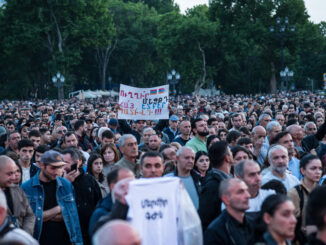
Two rallies are held at Liberty Square in front of the Opera House in support of the former leader organized by former Pan-Armenian National Movement (HHSh) leaders such as Alexander Arzoumanian, the Foreign Minister during Ter-Petrossian’s reign who was detained for several weeks by the National Security Service on charges of an allegedly suspicious bank transfer. At the first rally on Oct. 26, Ter-Petrossian declares his intention to run as a candidate in the 2008 presidential elections. He garters the backing of other political parties as well, such as the Social “Hunchakian” Party, which earns insignificant public support. The Impeachment/Aylentrank movement, strong supporters of the former HHSh regime co-led by Nigol Pashinian, the editor of the Armenian Times daily newspaper, are the main backers of the former president’s return to the political arena.

Other parties remain undecided on who they wish to support in the presidential race—on whether to swing their weight towards the opposition forerunner Ter-Petrossian or field their own candidate. Former coalition member Orinats Yerkir does not give any indications, although its leader and former Speaker of Parliament Artur Bagdasarian makes regular appearances on television talk shows.

Member of Parliament and former Foreign Minister under Ter-Petrossian’s reign Raffi Hovhanissian also does not speak publicly about his intentions to run in the elections or to support another existing candidate, but a Nov. 23 decree from President Kocharian states that Hovhanissian is unable to present himself as a candidate, citing citizenship requirement issues. Hovhanissian, originally an Armenian-American, was only granted citizenship in 2001 despite serving in the first administration’s government in 1991. The Armenian constitution stipulates that candidates can only run for president after having been a citizen of the republic for 10 or more years.

Vasken Manougian, another former leader of the Karabakh Committee and one-time defense minister during the 1990s, gives limited criticism of the authorities as well as Ter-Petrossian’s ambitions, but makes no pledges of support for a contender in the presidential race, although some anticipate he will announce his candidacy.

The ARF-Dashnaktsutiun, long at loggerheads with Prime Minister Sarkisian, announces by September that they will field their own candidate pending approval by their special party assembly.

Ardashes Geghamian was silent until announcing his candidacy on Nov. 27, while sharply criticizing Ter-Petrossian’s tenure as president.


Political Unrest

Ter-Petrossian’s return to politics brings with it several politically motivated arrests and investigations. Sympathizers to Ter-Petrossian are detained or beaten, sometimes in broad daylight. Companies belonging to prominent businessman Khachatur Sukiasian, whose now modest empire took root during the Ter-Petrossian era, are investigated on suspicion of tax evasion. In Gyumri, a television station known simply as GALA also endures investigations by tax collection authorities after broadcasting Ter-Petrossian’s speech given at the Marriott Hotel in September.

In the wake of the May parliamentary elections, celebrated Karabakh war veteran and political activist Jirayr Sefilian is arrested on charges of illegal arms possession. Authorities become unnerved after he addresses his Alliance of Armenian Volunteers organization’s congress calling for a drastic change in the country’s leadership by any means necessary. Police find a pistol belonging to Sefilian, which had been presented to him as a gift by former Nagorno-Karabakh Defense Army Commander in Chief Samvel Babayan. Two fellow members of Sefilian’s organization, Vartan Malkhasian and Vahan Aroyan, are also detained, the latter also for arms possession. After six months in detention, the trio is sentenced to serve one and a half to two years in prison. Sefilian and Malkhasian intend to appeal the rulings.


Conspicuous Economic Progress

By the end of November, the dram reaches an all-time high against the dollar at a street-trading rate of 280, up from 445 in 2005 and 580 in 2002. Prices for most goods and services remain stagnant or increase while the dollar’s value continues to drop, escalating the widespread belief that Armenia’s economy is largely dollar based. Staple foodstuffs, such as bread, sugar and dairy products increase by 50-100 dram or more overnight.

The Central Bank of Armenia insists that the influx of over $1 billion in remittances as well as the continued devaluation of the dollar promote the currency’s strengthening, while International Monetary Fund and World Bank representatives laud Armenia’s booming economy largely fueled by expansive construction projects underway mainly in the capital’s downtown area. Yet, the outlying areas of Yerevan see little to no benefit from the strong economy with joblessness and poverty still rampant.

Reported speculation in the dram’s appreciation by former Central Bank economists does not cause much alarm with consumer spending largely unaffected. Spending from January to August alone increases 13.9 percent according to figures released by the National Statistical Service (NSS).

The Armenian government announces that its projected state budget will be approximately $2.5 billion in 2008, up from $1.5 billion this year and $1 billion in 2006. President Kocharian promises a crackdown on tax evasion with the State Tax Service engaging in audit investigations of selected prominent businessmen. The agency vows to raise the amount of state revenue generated from collected taxes to 20 percent in 2010.

Russian capital conglomerates gain a stronghold on Armenia’s infrastructure. Armentel, previously owned by the Greek-owned OTC with a 10 percent stake held by the Armenian government, is sold to Vimpeltel. Months later Vivacell, Armentel’s sole mobile phone service provider competitor, and its parent company K-Telecom, announce their 80 percent buyout by Mobile TeleSystems (MTS) secured in a near secretive deal, with the remaining 20 percent to be optionally acquired within five years.

Control of a new gas pipeline between Armenia and Iran is gained by Russian-managed ArmRosGazprom, already providing service to most of Yerevan and throughout the country. The move is strongly criticized by opposition groups as the pipeline would secure an alternate source of gas reducing long-term energy dependency on Russia.

Midland Resources Holding, an offshore company that owned Armenia’s electrical grid for a short time with no prior experience in the energy sector, was hastily sold in a deal completed in 2006 to Unified Energy Systems (UES), which pledges in April to spend as much as $74 million to renovate the network within a three-year time span. The Hrazdan Thermal Power Plant had already been transferred to ArmRosGazprom in 2006 in exchange for reduced natural gas tariffs lasting until 2009.

Only the country’s waterworks system, controlled by the French firm Veolia Eau, remains untouched by Russian influence.

Moscow pledges expanded investment and trade with Armenia in October talks between Russian President Vladimir Putin and President Kocharian.


Justice Falters

Armenia’s judicial system receives continued criticism under the scrutiny of the general public as well as foreign observers. In July, an unprecedented court ruling overturns the convictions of the chief executives of Royal Armenia, a company that deals in coffee packaging.

The two men, Gagik Hagopian and Aram Ghazarian, served nearly two years in prison on trumped-up charges of tax evasion and fraud. Their trial and conviction followed accusations of bribe extortion by the State Customs Committee, widely considered to be one of the most corrupt governmental institutions in Armenia, which claimed that $3 million in customs taxes went unpaid by Royal Armenia.

Judge Barkev Ohanian throws out the original ruling, releasing the prisoners at once. But in August, the businessmen again stand trial in the Court of Appeals of Armenia. As a result of the controversial ruling, the judge is dismissed by a presidential decree on accusations of bad conduct. After undergoing medical treatment in Spain, Hagopian is arrested on charges of refusing to appear at a court hearing and is subsequently jailed immediately upon his arrival in early October at Zvartnots International Airport, as he had anticipated. He was denied bail and remains detained.


Scandals Unproven

Corruption is linked to the World Bank’s projects in Armenia, specifically regarding the expected substantial repair of the waterworks system in Yerevan. Bruce Tasker, a consultant for the National Assembly appointed in 2004 to investigate the spending of a $30 million loan provided by the World Bank, accuses the institution of embezzling tens of millions of dollars from the project’s budget, with private accounting firms and government officials complicit in the affair. But the findings of the report after its completion were never revealed to Armenia’s general public and were only publicized earlier this year by Tasker himself on his website.

A 2006 World Bank Implementation Completion Report revealed that despite the project’s completion, 80 percent of the water distributed into Yerevan’s water distribution network is lost. World Bank officials purportedly involved in the scandal have yet to be held accountable for the alleged wrongdoings, and the institution refuses to acknowledge that misappropriation of funds may have occurred.


Energy and Environmental Issues

Both Russia and the U.S. pledge their support to assist Armenia in building a new 100 megawatt nuclear power plant replacing the existing Soviet-era Medzamor facility facing decommission in 2016. Such a project could be underway as early as 2013.

Despite protests from environmental protection activist groups, the Ministry of Environmental Protection approves a controversial copper mining project. Some 1.6 million tons of copper and just under 100,000 tons of molybdenum are estimated to be contained in an untapped deposit to the north of Alaverdi in Teghut, located in the Lori region. Nearly 130,000 trees belonging to species indigenous to the area contained on less than 500 hectares of land will be cut as a result. Yet, the European-based company that will excavate the ore, Armenian Copper Program, insists that about 1,400 jobs will be created, thereby boosting the local economy. Over $200 million will be spent to extract the copper.

Armenian Copper Program is a subsidiary of Vallex Group, whose operations are based in Alaverdi where copper mining first began in the Soviet era. It has been criticized for releasing unfiltered sulfur dioxide measuring in the tens of thousands of tons into the atmosphere since the start of the company’s mining projects in 1996, without reprimand by the government. In the development’s wake, dozens of wildlife species unique to the forest will be wiped out (Some are considered to be endangered by the International Union for the Conservation of Nature and Natural Resources.) The company claims that it is initiating reforestation projects in other areas of Lori in an attempt to balance the already existing ecological destabilization.

Keyword: