
TOC


AWOL Home

Reflections on the Armenian Weekly, the ARF, and the Armenian Nation: An Interview With James H. Tashjian

Interview by Garo Adanalian

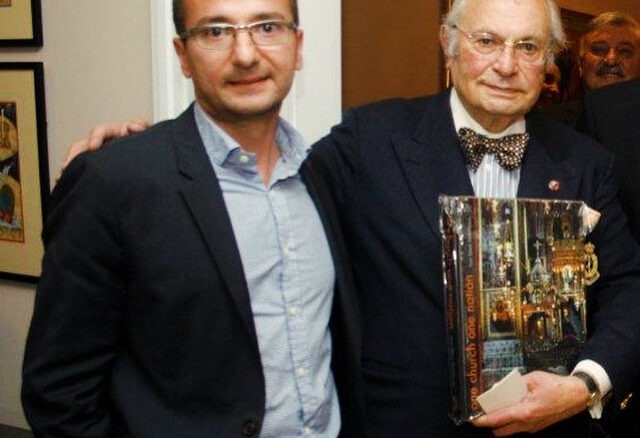
On the occasion of the 70th anniversary of the Armenian Weekly, the following interview was conducted with long-time editor James H. Tashjian, on April 29, at his home. Mr. Tashjian served as editor of the Armenian Weekly for over 30 years and was also editor of the scholarly journal Armenian Review until 1982. Current Armenian Weekly editor Jason Sohigian also participated in the interview.

The text was transcribed as accurately as possible. Mr. Tashjian’s comments are edited for length and clarity (for example, “Russian Armenian” has been changed to “Eastern Armenian”) but are otherwise verbatim. Readers should also note that the Armenian Weekly was known as the Hairenik Weekly until 1969.

Garo Adanalian: The Hairenik Weekly was first published in 1934. Wasn’t it founded as an organ of the AYF?

James Tashjian: It was the organ of the ARF, and then became an organ of the AYF. But that was really only titular. It was the property of the ARF at all times. But they gave us the privilege of putting everything that the youth wanted in the paper. There were no restrictions at all. Of course, all ARF developments of major proportions were carried out beautifully and thoroughly, so much so that they [the readers] used to complain about it. I suppose they still do. I’ve heard many complaints about the extensive coverage in the Weekly of news from Armenia, when actually there has been an absence of news of the community.

In my opinion—and this [former Hairenik Editor] Reuben Darbinian agreed with as well as the ARF in those days—the Weekly’s job was to serve the Armenian community in this country. For that reason we carried extensive sports news, for example. The AYF followed our lead, so to speak. They had extensive basketball leagues, baseball, and so on. But we are not going to go into all that today.

GA: When you were the editor, were you told what to print and not to print?

JT: There was some control over the Weekly—while Mr. Darbinian was alive there was no control at all. Later on a so-called group of reformists, around 1975, changed the methodology of what we were doing.

GA: How so?

JT: They thought there was too much AYF news. They had flamboyant ideas of how the Weekly should run as an Armenian paper in America. Their leadership of the AYF and the Weekly waned over the years, but the damage was done.

But as far as I am concerned, the Weekly is the best thing on the market today.

GA: When did you first become involved with the Weekly?

JT: When I was in high school. Surprisingly, the Central Executive of the AYF asked me to be the sports editor of the paper, and of course at the time I was involved in college football and hockey and so forth. I said that I would be glad to do that—I became interested in the paper. When I joined the AYF, I took a good deal of interest in it. But the thing I enjoyed so much was that the AYF Central Executive was in a supervisory capacity of the Weekly and they never bothered us.

We had several columnists, such as K. Merton Bozoian (Uncle Bozo) and so forth. I made a list of people that were involved both with the Weekly and the AYF—you can’t distinguish one from the other. There was General Karekin Nejdeh, of course, who was the founder of the AYF.

Some of the other early AYF leaders I wanted to remember today are John Hovhanissian, James G. Mandalian, Armen Bardizian, Arthur Giragosian, K. Merton Bozoian, Popken Hachikian, Berge Aslanian, Dick Hagopian, Harry Sachaklian, Hagop Mooradian, and Florence Kasparian Kazanjian.

GA: At that time you couldn’t distinguish the Weekly from the AYF?

JT: No you couldn’t. The AYF is a totally different entity today. Unfortunately, perhaps because the world has changed, or perhaps the candidates for membership have changed, I don’t know. There has been a change and it ought to be studied. I think what you have to do—both with the Weekly and the AYF—is concentrate on the younger members.

Frankly, the Weekly is not being read by the people that ought to be reading it. Many AYF alumni have told me that they are reading the [Armenian] Reporter. Why? They tell me, “Gee, that news from Armenia is very good. The struggles and difficulties they’re having, their dialogues or lack of dialogues with the Turks.”

It just isn’t enough. We need a dynamic newspaper covering the Armenian-Americans and their lives. That’s what we need and we haven’t got it. The Reporter comes closest to it. You have a job on your hands to convert the Weekly’s mission.

Let me cover these people that were involved with the Weekly and the AYF. I cannot stress enough the closeness of the two. I became involved with the AYF administration without even having become a member! While I was there I was fortunately able to assist both the AYF and the Armenian Weekly.

It was a glorious experience, really, especially while Reuben Darbinian was alive. He was the greatest Armenian mind. He was the sort of man that could teach at Harvard or Yale, yet he was modest. He was a great friend of the young people. He held several advanced degrees.

GA: How did you come to know him?

JT: My father used to go to the Hairenik all the time and visit with Mr. Darbinian. When I finally entered the ranks of the employees of the Hairenik I came to know Mr. Darbinian as a person and as a leader. I became very close to him, almost like a son.

Jason Sohigian: Who would do the translations of his articles into English?

JT: Mr. James G. Mandalian used to do that, but there was a problem with that because Mr. Darbinian had been educated in Eastern Armenian. But remarkably, when he came to the Hairenik in 1922, he learned Western Armenian so that people could understand what he was saying.

I can’t compare myself to Mr. Darbinian. I couldn’t be the man that he was. He was a remarkable person—and when he passed away there were only 30 people at his funeral. He was perhaps the last living representative of his heroic government. His history in the ARF and with Armenians alone would astonish.

GA: What role did he play in the First Republic?

JT: Mr. Darbinian was among other things the Minister of Justice in the First Republic. He was also one of its leading diplomats, visiting Moscow on various diplomatic missions.

Then there was James Mandalian, who was the second editor of the Hairenik Weekly, as it was called at that time.

GA: What was your relationship like with Mr. Mandalian?

JT: We were like brothers. I admired him because of his intellectual facility, and he was a rather interesting man personally. He supported everything we had to do, and his Weekly reflected that. By the way, he was the first executive secretary of the AYF, and he was a very successful one.

And now let me tell you about the first editor of the Weekly, Armen Bardizian. I didn’t know him very well. I was in school at that time, back in 1934. He was a combatative man, and he didn’t last long. Mr. Mandalian came along and took his toga away.

JS: Who was the columnist Politicus?

JT: Politicus was Harry Boyajian. His son, David, is the fellow that supplies you with articles from time to time. When he first started writing for the Weekly, he was a rabid leftist. But later on when I met him professionally, he had changed his tune to the right. He was conservative, but was a very able man. I used to have a lot of arguments with him, but in the end he came out all right. He undoubtedly had some experiences that led him to do what he did.

GA: What was it specifically that you hoped the Armenian people would achieve, comparing the Armenian Cause then with now?

JT: First of all, I am strictly against the Armenians attempting to enter into a dialogue with the Turks. I read in today’s Weekly that TARC seemed to have failed, that they broke off relations with the Turks, which is favorable in my opinion. We have nothing to give the Turks, and the Turks have an enormity to give to the Armenians, which they will never give.

GA: How do you think we will be able to get back what the Turks owe to the Armenians?

JT: I don’t know. People with greater minds than mine have struggled with that question for years. You see, Garo, we have nothing in Armenia but stone. The Turks on the other hand are sitting on historical Armenia, on the other side of the Arax River. Will they give us any portion of that land? Never.

On the other hand we have a problem with Russia, for instance, geopolitically. Are we a Caucasian nation? No, but even the American government considers us a Caucasian nation. But we are separated from the Caucasian chain by Georgia and Azerbaijan. What are we then? We are a Middle Eastern nation. Our mountains extend from northern Asia Minor right into Armenia and finally Persia.

On what basis do we advocate negotiations with the Turks? Would an apology be the answer? That won’t bring back the 1.5 million, will it? The Turks could make categorical history by coming out and saying, “We are sorry that we massacred the Armenian people.”

A friend of mine who visited Turkey some time ago came back and said, “You know, Jim, I was talking to a Turkish intellectual.” They have intellectuals, but as far as the Armenian Question is concerned, they become bums, like everyone else. My friend said, “That man told me that Turkey has two enemies: one is the Armenians and the second is the Russians.” You see?

GA: When you’re talking about relations with Turkey, what do you suggest that the Armenian government should do?

JT: I think rather than going too deeply into that, what we have to understand is that we are lucky to have the Republic. We are damn lucky to have that. And it wasn’t the Russians that did that. The Russian attitude towards Armenia dates from St. Catherine and Peter the Great. Both of those tyrants regarded the Caucasian nations—as Armenia was deemed to be at that time—to be part of the great Russian nation. Understand?

Armenia today is part of the CIS. Why? Because we are a nation that separated itself from mother Russia. Circumstances prevailed in 1991 so that we formed our independence. We should rigorously hold that, and we are not going to do that if we are going to look to Russia as our salvation. Russia has never been our salvation.

JS: But Armenia faces a choice between Turkey and Russia to protect its borders—right now Russia is the one guaranteeing Armenia’s existence.

JT: Is that so? I doubt it. I think the Turks do not move on Armenia because they regard the Russians to be in that position. I am interested in what the Armenians regard! It will be easier for Armenia to be annexed to Russia than to Turkey of course. You see? These are questions that have occupied the Armenians for too long.

We’re a nation! We should understand that we’re a nation. If Armenia really wants to be recognized as it should be, worldwide, it should strike oil. A major reason for this war in Iraq is because of oil. But if you find oil in Armenia, you’ll find most of the nations in the world coming to our assistance. The oil field that extends from Basra in Iraq to Baku certainly extends to Armenia. Look at the map.

GA: Have you been to Armenia?

JT: No I haven’t, and I am not going to Armenia in the near future because I don’t want to be disillusioned. I read the news about the poverty there. Armenia’s plight today is that is has no outlet to the sea. It’s futile to ask the Turks to give us back Trebizond. It’s ridiculous. The Persian Gulf is too distinctly difficult and far away from us. We have to have an outlet to the sea for our industries.

GA: So given its geopolitical circumstances, what do you think Armenia’s salvation will be?

JT: It will be when Turkey is bankrupt, just like the Soviet Union.

GA: It has gone bankrupt, but the United States is keeping it afloat.

JT: The United States is doing that, but we have to wait for international developments to create a US-Turkish enmity. That can be predicted. One of the recent examples is the recent refusal of the US to allow Turkish troops into Iraq. We could use have men in this war, but Turkey was refused allowance into Iraq.

The Turks are not happy with the status of the US airfields in Incirlik. What you have is a fundamentalist government in Turkey and they are not fully happy with America, except that America’s money is keeping them solvent. Right now, there doesn’t seem to be any reason to look forward to changing the status of the Armenian republic. Hopefully Russia will not act in that.

JS: I don’t think that’s a question right now.

JT: Right now, I agree with you. But in the event of an international explosion, you can be sure that one of the first nations that will be taken over by the Russians for “its own security” is Armenia.

JS: I first visited Armenia a few years ago. Even though there’s a lot of poverty, it’s a great feeling to be on our land. I recommend it—it’s the first time you feel truly at home.

JT: You recommend it? Then let me put on my hearing aid to listen to you (laughter). No, I really don’t want to be disillusioned. I have relatives in Gyumri, a third or fourth cousin, who is an educated man and was a professor at Yerevan State University. He is now cleaning streets. You see? There’s no reason for my going because I can’t help them. There’s nothing I can do, nothing we can do to really assist them.

But visiting would be nostalgic. It’s Armenia, it’s my parental nation. On the other hand—and this we used to teach the AYF and Mr. Darbinian was totally in favor of it—that we were damn lucky to be admitted into America. If we hadn’t been, our parents would have been forced to stay in Syria, in Lebanon, in Iraq. You see?

We should be grateful to America—that doesn’t mean politically. You can be what you want politically in this country. Being an American is connotated, you understand? The idea of America being a melting pot of ethnic groups is nonsense. We ought to remain an Armenian group in America! We can do that too if we pull the right strings, with the leadership we need.

GA: Do you think that the new Armenian-American generation should start to repopulate Armenia?

JT: I don’t know Garo. Let me tell you something that’s very odd. In my day when I was in the AYF there were only a handful of people who were students in college. They gravitated to the AYF—I don’t know why, but they did. That generation was AYF heartfeltly, but today things are different. There are so many around here that are all college graduates, but are they deeply interested in the fortunes of their parent people? I see little interest, except in dances (laughter). But I see virtues in social affairs too.

The Boston AYF Chapter at one time used to have a Grand Ball every November or so, and you’d find thousands of people there—thousands. I don’t see any AYF activities socially. It’s not enough for the kids to write for your children’s page [the AYF Page]. That can’t be the only activity of the AYF.

In my opinion, the only organized group worldwide today that can do anything to alleviate matters concerning the Republic is the Dashnaktsutiun. Never mind today that they are submerged over there—what are they, the third largest group? That’s because—I won’t even talk about why...

GA: As you know, it’s the 70th anniversary of the Weekly this year. Given that you were there for about 30 years, you are for the most part an expert on what the Weekly was. What are your views on what the Weekly will be in the next 70 years?

JT: I can’t predict that. But I will stress again that the only force in the world today that can do anything about Armenia is the ARF. It is the only organized force that can really operate to save Armenia, to expand Armenia, and to make it what it ought to be—a real nation, a nation in all respects. Without that force in this country, I don’t think the Armenians can very well achieve any goal.

The forces against us are remarkably strong. The AGBU today is doing what the Ramgavar party was doing before—collecting money, it has millions. This is their prime activity. Most non-Dashnaks have gravitated to that organization.

But our virtue is that when we receive a dollar, we do not accumulate it. We spend it on things that are needed in the community and in Armenia to the best of our ability. That’s why we are not an organization with many millions of dollars in reserve. We spend in terms of Armenians. What are their needs? I don’t know at this point.

JS: Because of the work that you’ve done at the Weekly, you have laid a solid foundation for what it is today. You have given some advice and some ideas here, but we wouldn’t be here today if it wasn’t for the work that you and others have done.

JT: The principal suggestion I might have is that you make it an Armenian-American newspaper. Your principal goal is to strengthen the community in this country. And in strengthening the community, you are strengthening Armenia, so that we can do what is needed. I think that without America, Armenia would have difficulty even existing. We are the principal buttress that Armenia has today. Without this community, Armenia cannot function.

You know, all these people that are going to Armenia and coming back are doing exactly what the Dashnaks wanted. Do you realize that? Your job is with purpose—to strengthen our community, the Dashnak community in this country, to create a fraternity, to create a feeling amongst ourselves that will swallow those people up and make them Dashnaks. It’s our job to teach our own people first, and to teach the others after that.

The ARF has made some errors, there’s no question about that. But overall, since 1890, it has been the Armenian community worldwide. If it weren’t for the AYF and the ARF, there would be no community in this country.

You have a whole community of former AYF members out there who today are not active. They can be brought back into the fold. How to do it? It’s up to the organization’s leadership. They can do it, but not by preaching socialism or anything like that.

Let me tell you something about socialism. In an emerging country like Armenia, I am very happy that we have what we might call a socialist government. Except that there is nothing going on that is socialistic that I know of. They are an emerging country, and they need a form of government that at least distributes equality amongst the people.

You have Armenia with its pro-Russians, with its pro-nothings. You have people like that because Armenia is a nation of different people—it’s inevitable. But we do what we can....