|
The
Armenian Land Question—Misunderstood Terrain
By David B. Boyajian
Geography, someone once said, is destiny. If so,
the present geography of Armenia poses major challenges for its
future.
Small and landlocked, Armenia is outflanked by Turkey
to the west and Azerbaijan to the east. To the north, unreliable
Georgia controls Armenia’s routes to the Black Sea and Russia. To
the south, thankfully, lies friendly Iran. Unfortunately, the Iranian
provinces just to Armenia’s south contain millions of Azeris who
might someday blockade Armenia by forming an autonomous pan-Turkic
corridor from Turkey to Azerbaijan.
To endure and prosper, Armenia must somehow break out
of its geographical straightjacket by reclaiming the lands of
historical Western Armenia, which, as we know, lie mostly within what
is now called eastern Turkey.
That territory was the primary site of the 1915-1923
Genocide, and much of it was to be incorporated into the Armenian
Republic in 1920 by the Treaty of Sevres, which Turkey signed but
later renounced. Perhaps four times the size of the current Republic
of Armenia, the treaty territory constitutes about 15 percent of
present-day Turkey. Significantly, it included a coastline on the
Black Sea.
WHY LAND?
Today that coastline would provide Armenia with a
direct sea route to Europe and Russia. Georgia would lose the
potential to deny Armenia access to much of the outside world, and
Armenia would be less vulnerable to a Turkish land blockade.
Armenia’s economy and national security would be strengthened.
Eventually Armenia might develop an ocean-going navy,
including submarines that could endow the country with a stealthy,
survivable defense capability.
Present-day Armenia with its limited, rocky soil has
trouble feeding itself. Regaining its well-irrigated, traditional
breadbasket in Western Armenia would clearly be beneficial.
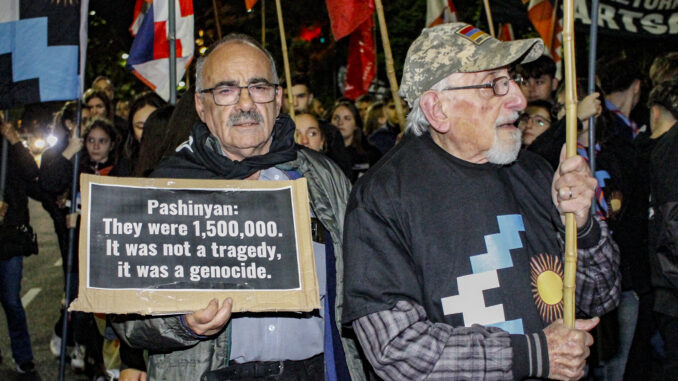
Recouping territory is also simple justice, restoring
what Turks took from Armenians in the carnage of 1915 and by centuries
of massacre, deportation, confiscation, onerous taxation, abduction,
rape, and forced Islamization.
Says political scientist Khatchik Der Ghougassian,
Turkey in 1915 “intended to redefine the geopolitical situation by
eliminating Armenians from Asia Minor. Thus, a response to the
Genocide must deprive Turkey of the geopolitical map it made possible
by committing genocide.”
Additionally, Turkey has come to believe that it can
get away with killing huge numbers of Armenians and seizing their
land. It bodes ill for Armenia’s future if Turkey is not made to
unlearn that lesson.
But there are misconceptions about how and when
Armenia can regain territory.
REGAINING TERRITORY
Contrary to what some may think, no serious Armenian
analyst has ever suggested that Armenia can march over the Turkish
border next week and retake what rightfully belongs to it. Armenian
land can be resettled only in the long term, perhaps decades from now.
The most plausible scenario is war, unfortunately,
though not necessarily between Armenia and Turkey.
Instability breeds war, and there are few regions more
unstable than eastern Turkey where, for instance, on and off warfare
between Kurds and the central government has taken place for
centuries. Though the most recent war ended in 1999, some Kurdish
groups (Pkk/Hadek/Kongra-Gel) just announced a resumption of that
conflict.
Future military cooperation between Armenians and
Kurds, perhaps with Russian assistance, and a subsequent division of
the spoils—even if less than Armenians would like—is a
possibility.
Also possible is a conflict between Turkey and Russia,
who have fought at least eight wars in the last three centuries. Some
of the battlegrounds were in eastern Turkey. During World War I, for
instance, the Russian Army advanced deep into the Western Armenian
heartland. Only the Russian Revolution brought about a withdrawal. A
similar scenario, with Armenia itself possibly retaking some
territory, cannot be ruled out.
Neither should one underestimate the ability of
Armenians themselves to retake land. Against all odds, Armenians not
only won the battle for Karabagh in 1993, but also captured a buffer
zone of about 2,000 square miles within what is now Azerbaijan, where
comparatively few Armenians lived at the time.
Currently, the West and Turkey’s only route into
Azerbaijan and the Caspian region that avoids their Russian and
Iranian adversaries is through unstable Georgia. Were Georgia to
become further destabilized, Armenia would, in theory, possess
considerable leverage as the only remaining route. Might some land
concessions then be offered Armenia in return for its cooperation?
RESETTLEMENT ISSUE
Another misconception is that Armenians could never
repopulate Western Armenia since surviving among its several million
Turks and Kurds would be unrealistic. Again, no serious analyst has
ever suggested, nor would Armenians consider, repopulating territory
while it remained under Turkish control. Armenia or a friendly power
would need to administer the territory for it to be safe for
resettlement.
What about the Turks, Kurds, and others, many of part
Armenian descent, who now occupy homes, property, farms, and towns in
eastern Turkey that 90 years ago were Armenian? Admittedly, the
question has no simple answer.
There are, however, many precedents for large-scale
population movements. For example:
-
Azerbaijan’s attack on Karabagh more than a
decade ago led hundreds of thousands of Azeris in Armenia and
Armenians in Azerbaijan to flee in opposite directions. This was a
tragedy, yet a peace accord may someday allow many of these people to
return to their homes or be compensated.
-
After their war ended in 1922, Greece and Turkey
“exchanged” 1.5 million people—most Greeks in Turkey were sent
to Greece, while lesser numbers of Turks in Greece returned to Turkey.
-
Kurds are currently repopulating districts in
northern Iraq from which the former regime had removed them, though
not always in ways that are fair to the present Arab residents.
-
The Council of Europe is demanding that as many as
100,000 Meshket Turks, whom Stalin deported from Georgia to Central
Asia, be settled near Armenians in Georgia’s Javakhk region. Turks
deserve to be resettled, but not Armenians?
No one underestimates the difficulties. Even in 1920,
the Sevres Treaty in hand, the destitute survivors of the Genocide and
the impoverished Armenian Republic would have encountered difficulty
in returning to and administering their land. Indeed, Turkey
confiscated Armenian property and nearly eradicated Armenians in 1915
precisely to make it hard for the survivors and other Armenians to
ever return.
To totally dismiss the goal of Armenian resettlement
is, therefore, to reward Turkey for having created the problem in the
first place. Ultimately, the criminal, not the victim, bears
responsibility for setting things right.
Armenians do not, of course, wish hardship on others.
Still, Armenia deserves a measure of justice and security. If Turkey
wants to talk about that, Armenians have always been willing to sit
down at the table.
THE FUTURE
Admittedly, just holding onto Armenia and Karabagh now
is difficult, especially in view of the menacing
Turkish-Georgian-Azeri axis backed by the US. Frankly, it is even
conceivable that Turkey, in its ongoing drive into the Caucasus and
Central Asia, will someday overrun a piece of Armenia before the
latter gets even one inch of its territory back.
Armenia’s present state of affairs does not,
however, preclude us from considering how best to address the land
issue in the future.
Some Armenians have, unfortunately, convinced
themselves that even mentioning the land issue is too provocative. As
if the Genocide and subsequent land theft were not themselves the
ultimate provocations.
Remember, too, that Turkey—a relative newcomer to
the region, incidentally, and nowhere near as old as the Armenian
nation—is itself beset by political and economic problems and nearly
surrounded by less than friendly nations including Greece, Cyprus,
Iran, Russia, and others.
Just as few foresaw the independence of Armenia and
the disintegration of the Soviet Union, no one can predict whether or
how the land issue will be resolved.
Ottoman Turkey has, however, been shrinking steadily
for hundreds of years. Moreover, as it occupies Armenian territory and
rules over Kurds, Turkey can still be regarded as an empire. Be they
Roman, Byzantine, British, or Soviet, empires inevitably contract and
fall.
|