|
An Interview with Agos Editor Etyen
Mahcupyan
By David Barsamian
The following interview with Agos editor Etyen Mahcupyan
was conducted in Istanbul in late June.
David Barsamian—Tell me about Agos.
Etyen Mahcupyan—Agos has a history of 10 years and it is the
paper of the [Turkish-Armenian] community. It began with the
aim of opening up the windows and doors of the community to
the public at large, and bringing the Turkish public into
the community—understanding its problems and becoming
familiar with how an Armenian and a non-Muslim live in
Turkey. I think that goal has been mostly achieved in the
past decade, when Hrant was here.
In fact, he was thinking of making Agos more like a Turkish
newspaper, that is, liberating it from the communitarian
bonds. This is what we are trying to do right now. The
changes in the newspaper were already conceived by Hrant and
myself through several discussions last year. But we were
thinking of making those changes in the autumn, because this
is an election year and we have several problems. But fate
led us to make all those changes in February.
D.B.—How many Armenians are there in Istanbul and
Turkey as a whole?
E.M.—Well, most are in Istanbul now, and they number
about 60,000-70,000. No one knows the exact figure because
the polls and other surveys don’t often ask those questions.
Also, the Church does not have all the data about the
Armenians.
But it seems there are about 60,000-70,000 Armenians in
Turkey, about 95 percent of whom are in Istanbul. And of
course there are Muslim Armenians, who converted during,
before or after 1915.
D.B.—How many people read the newspaper? Do you
depend on subscriptions or kiosk sales?
E.M.—Half of it comes from subscriptions and the
other half from kiosk sales. We sell about 5,000-6,000 now.
The problem is that each issue is shared and read by maybe
8, 10 or 12 people. We know that sometimes two or three
families buy the paper together and share it during the
week.
D.B.—Tell me about Hrant Dink, who was a colleague
and a close friend of yours.
E.M.—Well, it’s still very difficult for me to talk
about Hrant. He was a very, very close friend. Not only did
we share political views but we also saw each other as
family and friends.
We used to talk six or seven times every day, on politics or
other subjects. He had incredible energy. He was a
politician, genetically I would say, because he didn’t
forget anyone he met. He remembered everyone by name.
Although he may not have seen someone for 10 years, he would
immediately remember their name and talk to them.
He was a soft-hearted and warm-hearted person. He made
connections with nearly everyone—with people who shared his
views and people who did not.
He was a typical Armenian, I would say. That is, he was a
very humble person. He enjoyed the daily details of life.
From time to time, I used to think that he was forced to be
involved in politics. He was such a rich person at heart. I
think a better way of life for him would have been maybe
being at the head of a school or a children’s camp. He was
that kind of person.
D.B.—Why was he assassinated?
E.M.—Well, the main reason is the political situation
in Turkey and how the political situation triggers Turkish
nationalism in such a way that young people without any real
beliefs and with fears in life are easily converted into
assassins. Hrant is not the only one who was killed in the
last 5-10 years, and almost all the killers came from a
nationalistic background and ideology. This shows how
nationalism works and how it’s manipulated in Turkey.
Of course, another reason is that he was an Armenian.
Otherwise, he would have been protected, at least. We know
that the people that were thinking of killing him were
planning for almost a year, and that the police and the
military knew about it.
There were many reports going to Ankara, but they did not do
anything. So this forces us to ask the question, “If Hrant
Dink was a Turkish person, would he still be alive?” I don’t
know the answer.
D.B.—He used to compare himself to a dove. Please
explain that.
E.M.—Well, the dove can fly, but does not want to fly
too far, you know. It flies and then it comes back to the
same place because it is accustomed to that place. That’s
why there are many doves in yards, around churches, mosques,
etc. It gives the impression that those doves, and not us,
own the place.
So this is a good metaphor for Hrant, because he really
owned this place. He owned it in his heart and in his brain.
He cared so much about Turkey, about the Turkish people and
Armenians in Turkey that in this sense he was also the dove
of the yard.
He never wanted to fly away because his life was in danger.
Everyone knew the threat to his life, but every time we were
out somewhere in Europe or in the United States, after two
or three days he would say, ‘What are we doing here? We have
to go back where we belong.’
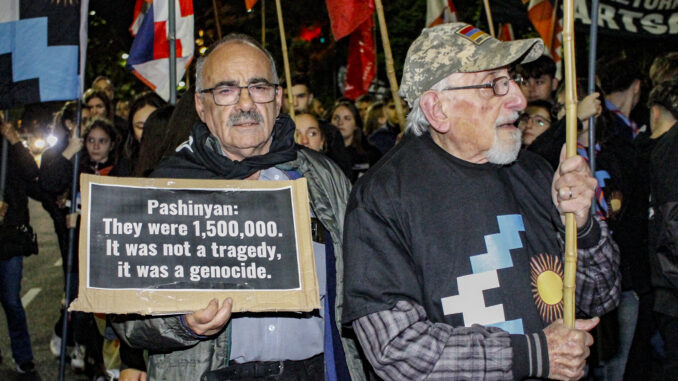
D.B.—His assassination triggered a very interesting
response here in Istanbul. Many non-Armenians—Turks, Kurds,
Christians—demonstrated and had signs saying ‘We are all
Armenians, We are all Hrant.’ Did that surprise you?
E.M.—The number of people is what surprised me.
Otherwise, I knew that the sentiment was there because there
is a huge change in Turkey. The problem with the Turkish
public is that they change but do not know how to make this
change felt in politics. So you don’t hear them as political
figures and you don’t see them in the streets. But when you
talk to them or you go out to Anatolia, you see that there
is a huge change in the mentality of the people.
I knew that many millions would mourn and cry for Hrant, but
I didn’t expect so many people to gather immediately after
his death. When his death was heard, there were 10,000
people in Taksim.
D.B—Do you feel the taboo about speaking about the
genocide is gradually being broken? Many writers, for
example the Noble Prize winner Orhan Pamuk, Elif Shafak and
others, are now speaking about it. It’s out in the open.
E.M.—Well, everyone knows about Elif Shafak and Pamuk
but there are many people in Turkey, especially historians,
who are writing about those issues. If we go to the
sciences, it’s not a taboo anymore. If we go to the people,
it’s not a taboo anymore.
When I went to Anatolia 10 years ago, people were irritated
and hesitant to talk about it. Now if you go there, they are
eager to tell you stories about what they heard from their
grandfathers. So there is no such taboo anymore
sociologically.
But politically, in regards to what the state or political
parties can and cannot do, there is this pseudo-taboo
because of the nationalistic atmosphere. And the
nationalistic atmosphere is using the “Armenian Question” or
the Armenian genocide as a tool. Because the main problem is
the issue of European Union accession. And in a world where
Turkey is part of the EU, those subjects will not be taboo
anymore. So the people who don’t want Turkey to be in the
European Union are using the Armenian genocide and the
Armenian issue at large to mobilize the nationalistic
atmosphere and stop the accession process.
D.B.—So it’s become, as we say in American English,
“political football.”
E.M.—Yes.
D.B.—Tell me about this Article 301 of the Turkish
penal code.
E.M.—First of all, I have to say it is not the only
article [causing problems]. But it is a very conjectural
thing that the state or the bureaucratic apparatus picks up
one of the items in the penal code and works on it and
everyone says, “What is this problem? We need to change it.”
And they change it and move to another article. So you
cannot change Turkey’s legal atmosphere by abolishing 301.
But 301 has its own special problems because it does not
differentiate between an insult and a more normal
argumentation and analysis.
So every time you pick up a topic that is related to
Turkishness, loosely connected to Turkishness, or maybe some
historical event that can be considered as an insult to
Turkishness, Article 301 can be used against you. This is
the problem with 301 and lately all those people that were
taken to court were taken by this article.
But I have to stress again, this is not the only culprit
here. The whole penal code is full of such articles. In
fact, one of the NGOs who works on those problems cited 10
or 12 articles like that—that can be used if the need
arises.
D.B.—“Insulting Turkishness” seems like an
interesting concept. For example, if I say that lahmejun
or doner kebab is very bad food, would that be
considered insulting Turkish identity?
E.M.—Well, this is I think showing that you are on
the edge of insulting Turkish identity, and you are picking
up the soft issues now. So the reaction would be, “We don’t
know what you will say tomorrow, so we’d better keep an eye
on you.”
D.B.—You want to advance Agos and to reach a larger
audience. How are you going to do that?
E.M.—Well, we have the online English version now. We
have great hopes for that although the subscriptions are
still very low. But we will continue to work on that and try
and see if the Diaspora is really interested in Turkey.
Because, of course, to be interested in Agos means to be
interested in Turkey. Otherwise, Agos becomes only a
sentimental issue for you.
So this is the main outlet that we have. Otherwise, you have
to know Turkish to understand the paper. Our surveys show
that at the kiosks, 70-80 percent of the paper are bought by
Muslim Turks. So in the last year or so, Agos has become
viewed a newspaper promoting democracy, instead of just an
Armenian newspaper.
As Hrant would say, we prefer the Armenian democrats and
Turkish democrats to be our subscribers, rather than just
the Armenian community. Because we know, and many Armenians
have realized, that without the democratization of Turkey,
it’s impossible to solve the problems of the Armenian
community today in Turkey. And it is impossible to solve all
the problems related to history.
D.B.—What are those problems in terms of civil rights
and human rights? Does an Armenian citizen of Turkey have
the same rights legally as a Turkish citizen?
E.M.—On paper, most of the rights are the same. But
when it comes to practice, you don’t see any public officer
who is Armenian, for example. This is an accepted rule in
the bureaucracy. You cannot even become a postman.
And why? Maybe because he wears a uniform. The ones who wear
uniforms, who are not doing their military service for one
year or six months or so should be ethnic Turks. This is not
written anywhere, but this is the practice.
Though if we were to ask the Armenians if they are against
this rule or not, I don’t suppose they would be very
interested because no one wants to be a postman or a
general. But our main problem is with the properties we have
that were confiscated during the last 30 years by the state,
and the state now does everything not to give them
back.
D.B.—What properties were these? In Istanbul?
E.M.—Yes, mostly in Istanbul. They belong to Armenian
foundations. And one has to realize that 30-35 percent of
the inhabitants of Istanbul were Armenians. Those properties
were mostly in central parts of the city and were hence very
valuable.
Those properties belonged to one or two million Armenians
and now, of course, there are only 60,000. Such wealth
belonging to such a small community. So the state tries to
bring new blockades to prevent the community from making use
of those properties, and they use several tactics. One of
the rules, for example, is that if the foundation does not
have a board of directors then it belongs to the state. But
there’s another rule that says that in order to be elected
to that board of directors, you have to live in that
district. Now, with 60,000 Armenians all living in different
districts, what about the districts where Armenians no
longer live? What happens after some period of time—10 years
for example? It automatically becomes state property.
The community is now trying to get those properties back,
and has filed two cases with the European Court of Justice.
So as I see it, with these big European processes, the
Armenian community has started to look for its own rights.
D.B.—Now if I lived here and were a citizen of
Turkey, could I buy a building or an apartment?
E.M.—As an individual, yes. But in the case of
foundations, we are talking about huge properties. In the
old days when there was a church, all the buildings around
the church were called vakfiye, because the church
would live on the income of all those properties. So
wherever there is a church, at least a few hundred
meters belongs to that community and not only the church
but also the schools, hospitals, cemeteries. All of these
are foundations and all of these have properties that are 5
or 10 times larger than the land on which they were founded.
D. B.—And what about historical places like Ahktamar
in Van, Surp Giragos in Diyarbakir, or Ani?
E.M.— Well, these are simpler problems because they
have symbolic value, but they don’t belong to any
foundation. They become museums and so on. So they are not
part of the Armenian wealth in Turkey, but are symbols of
the Armenian past.
So there is a political side to it, but it is also an easier
problem to solve because, as I said, those buildings will
become museums and would be governed by the state.
D.B.— But are they properly identified as
historically Armenian or are they called “Byzantine” or
“ancient”?
E.M.—The bureaucracy does everything not to call them
Armenian. They change the words, the letters, etc., trying
to make it sound like a Turkish word and so on. But it is
getting more and more difficult.
On the other end, we have to realize that in 1915 there were
about 2,300-2,500 churches on this land, and today we only
have around 35. Many are in ruins now, and perhaps we cannot
do much with those, but there are around 300 that can be
renovated.
This is a huge job for the state, and it is very hard for a
nationalist Turk to accept that those ruins belong to the
Armenians because that would be accepting that all those
people once lived here. And then one would ask, “What
happened to those people?”
So the renovation is going very, very slowly. What makes one
optimistic, however, is the initiative taken by some Muslim
Turks in Anatolia who have gotten together and said,
“There’s a church here. It’s an Armenian church. We want to
keep that church. We want to renovate that church.”
In many places, the Muslim Turks are trying to at least
allow that historical land site to be recovered and used
again.
D.B.— What did Hrant Dink think and what do you think
about some diaspora Armenians who may have very sharp
opinions about what you should be doing here inside Turkey?
E.M.—It shows that people are still maintaining their
identity as a community when they are thinking and saying
what the others should do. I think one must understand the
feelings and sentiments of those people, but we always
thought that politically they are not doing the right thing.
D.B.—Explain how.
E.M.—Politically, if the genocide is the main thing
and Turkey has to accept the Armenian genocide, it’s obvious
that a Turkey that’s in the European Union would be in a
position to accept the Armenian genocide more than a Turkey
that is out of the EU. So one would expect the diaspora to
be for Turkey’s EU membership. But what we see in some
circles of the diaspora is an approach to punish Turkey. Of
course they are right, and I understand those feelings, but
punishment of the state means the punishment of the society
as well. But the society has changed and is no longer the
society of 1915. There are parts that haven’t changed, of
course, like those people who killed Hrant, but the majority
is different.
And you cannot defend the Armenian Cause by punishing
another society. The state is something else. You can go
against the state because it’s a deliberate actor. If the
state is acting unethically—and most states are always
acting unethically—then there is a point there, and you can
do politics on that level. But as soon as you divert your
energy and try to punish the society as well, it brings a
backlash, and it’s absurd, and it makes the lives of
Armenians here much more difficult and much more
meaningless.
D.B.—So it’s easier for someone sitting in New York
or Los Angeles to talk…
E.M.—Always! Just as it’s easier for us here to talk
about New York. We know that the diaspora had a difficult
life in those lands because they went from Turkey, and in
Turkey the community was based on a religious authoritarian
understanding. There was a patriarch, and the patriarch
still in Turkey is supposed to be the leader of community.
But when you go to Europe and to the States, you are in a
very secular country. Of course, there are still patriarchs,
but they don’t have the same influence on the public
anymore. So you need something else to keep the community
together. So the Armenian genocide is a workable tool in
that respect. Also we have to realize that if you build the
community on a secular historical issue like this, then you
create a power relation within the community. You create a
hierarchy within the community.
And that power relation and that hierarchy takes the
community farther away from being a democratic community.
And what Hrant was after was forming democratic Armenian
communities all over the world.
D.B.—And what are your relations with the Republic of
Armenia, beyond language and culture?
E.M.—In our daily lives, we don’t have much of a
relation really. But all Armenians are becoming more and
more interested in what is happening in Armenia. Of course,
with Armenia so close to us, we have a feeling of…
D.B.—Comfort?
E.M.—Confidence maybe. It is very difficult to
pinpoint those feelings because there are no surveys on
that. But as far as I see from Agos, the Turkish-Armenian
community is really interested in the news items concerning
Armenia.
I think that with the EU process and the relations that were
established in 2006 between the EU and Armenia, everyone is
realizing that in 10 or 15 years, we will have Armenia and
Turkey in the same package. This may happen. If Turkey is a
bit late in the accession, the probability of such a
scenario becomes higher. So, what is happening in Armenia
will be very important for the Armenian community here, just
as what is happening in Turkey is important.
D.B.—Right now, the border is closed, isn’t it?
E.M.—The border is closed if you go by car. But if
you want to fly, it’s open. There are several flights every
week. I think the Turkish government wants to solve that
problem, but with the election this year and the
nationalists, it seems they are waiting for the right
conjuncture to take that step.
David Barsamian is the founder and director of
Alternative Radio (www.alternativeradio.org).
|
|

 |