Home
Front Page
Commentary
Columns
Politics
Community
Feature
Youth
Calendar
About us
Contact us
Subscription


Volume 73, No. 45, November 10, 2007

Turkey, Armenians and Kurds

An Interview with Ron Margulies

By David Barsamian


Special to the Armenian Weekly

When Orhan Pamuk, Turkey’s Nobel Prize winner for literature, said that more than one million Armenians and 30,000 Kurds had been killed in his country, he was not only publicly vilified but also prosecuted by the government. And he’s not the only one who has gotten into trouble for speaking out. Breaking the taboo and talking about the 1915 state-organized and directed genocide of the Armenians and the plight of its large Kurdish population is dangerous. Witness the murder of journalist Hrant Dink. The Turkish government takes out full-page ads in the New York Times denying the genocide. It warns of retaliation against the United States if the Congress acknowledges a historical fact. Ankara is also threatening to invade Iraq in pursuit of Kurdish fighters.

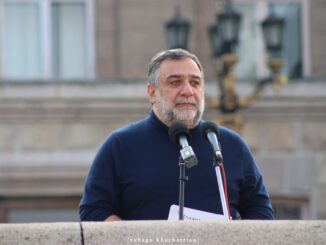
In this interview, conducted in Istanbul on June 24, Ron Margulies talks about the Armenian and Kurdish issues in Turkey.

Margulies was born in Istanbul and was educated there and in England. In addition to being a political activist and commentator, he is a well-known Turkish poet and has published seven books of poetry.

David Barsamian—Turkey has been an ally of the United States for decades and is part of NATO. In the run up to the war on Iraq, it was almost taken for granted that Turkey would participate with the United States. Bush Administration officials, people like Wolfowitz, were shocked when Turkey did not climb on board the U.S. war juggernaut. Explain what was going on here.

Ron Margulies—We, the antiwar people in this country, were probably as surprised as the Bush Administration. We were fighting very hard to stop the government from taking part in the war, but I must say, most of us thought, “Okay, we’ll have a go, we’ll have a fight, but chances are at the end the government will vote to go with the U.S.” It’s not a common thing by any means for a Turkish government to do something so blatantly against the wishes of Washington. But there were, I think, two elements why on the 1st of March in 2003 the Turkish parliament voted not to allow the U.S. to station troops in southeastern Turkey and to use the border between Turkey and Iraq for an attack on Iraq.

The first one is we had a huge, very popular anti-war movement. And on the 1st of March, when parliament was in session discussing the American demand, we had about 100,000 people out demonstrating outside parliament in Ankara. The campaign against this had been going on for many months, and it had become widespread, legitimate. We had considerable media and, of course, popular support. So this was one element. The government did have to take the anti-war feeling and the anti-war campaigning in the country into account.

The second element is this: We’re talking of a government which comes from an Islamic tradition. I don’t believe it is an Islamic government in any sense at all, but it’s a breakaway from what was an Islamic party. So although I would not describe this government as Islamic, nevertheless it comes from that tradition, which means many of its members in parliament and outside certainly were not in favor of attacking a neighboring country with a Muslim population. It would have gone against all their instincts. So in a way, we, the anti-war movement, were pushing against a door which wasn’t resisting a great deal.

Perhaps a third element is that the armed forces would not have been very clear in their own minds that they wanted to take part in this. There was a lot of debate at the time about what would Turkey get out of this and what would it lose. The military would have thought, “Do we want to get involved in this adventure?” Possibly many of them thought, “No, we don’t.”

On the other hand, Washington was bribing Turkey in a very clear way. Billions of dollars were being offered to Turkey if it were to go in with the Americans. So that was why there were some people in the government and in the powers that be who did want to go in. But the majority of the population was certainly against the war. In the end, the majority of people, both in the government and in the ruling circles, probably thought, “This isn’t going to be worth it.” So we had a big movement, but also, the rulers of this country were not sure that they would benefit from joining Washington in the attack on Iraq.

D.B.—You mentioned that people would feel uncomfortable invading a Muslim country, Iraq, a bordering state. Afghanistan is not a bordering state but it is a Muslim country, and Turkey is part of the NATO force there.

R.M.—It is, but I’m not at all sure to what degree Turkey is involved in military operations. For example, there are constantly American and British troops dying in Afghanistan. To my knowledge, there have been no Turkish deaths in the country. So the role Turkey is playing in Afghanistan must be a very secondary one in military terms.

Turkey has also sent troops for the so-called peacekeeping force in Lebanon. Again, there was huge debate in the country at the time—this is at the end of last summer—about whether Turkey should send troops to take part in the UN operation in the south of Lebanon. The same debates came up. There were people saying, “We can’t stay out of this because we need to be some sort of international power. We can’t become an international power by keeping out of all these flash points.” And then most of the population, and a very sizable minority in ruling circles, were very hesitant for the same reasons. They thought, “Is this worth it? Do we really want to get embroiled in this mess?” In the end, they did send troops. But the government’s arguments were humanitarian ones. I don’t mean I believe them, but what I mean is they had to put it in terms of, “We’re going out there to help the Lebanese people rebuild their country rather than for any military purpose.” I suspect it’s a similar scenario in Afghanistan. I’m not aware of Turkish troops playing a front line role.

D.B.—I’ve heard that foreign minister (now president) Abdullah Gul has boasted that after the United States and Great Britain, Turkey has the third biggest share of the private contractor pie in Iraq. Does that sound accurate?

R.M.—It does. But you have to bear in mind that before the Iraq war, Turkish construction contractors had a huge market in Europe, as they did, of course, in the rest of the Middle East. Not for any reason of religious affinity but because it’s a neighboring country. Economically it’s probably the most advanced country in the region. So you would expect this to be the case. So Turkey would have had a strong position in Washington in saying, “Well, we should be given some of these contracts.” Saying that Turkey is the third largest probably hides the facts. I don’t have the figures, but I’m pretty sure Turkey would be third by a very large margin. We all know what American companies are doing there. Turkish companies are operating on a much smaller scale.

D.B.—The political situation inside of Turkey is complex, as it is in every country. Groups are called Kemalists, nationalists and Islamists. Can you sort out these terms?

R.M.—Let’s start with the Kemalists and the nationalists. In reality, they are one and the same. There are what I suppose the mainstream Western media calls ultranationalists, what I would call fascists. Turkey has the largest fascist party in all of Europe. It has been a part of coalition governments in the past. It has a large membership and in the 2002 election, garnered just short of 10 percent, a sizable vote. And that had come down. It used to be higher. So we have an ultranationalist, fascist party. But when people say nationalists, usually that’s not who they mean. Kemalism is the ideology of the people who run this country. It’s the ideological cement of Turkey. What it means is this: Kemal Ataturk was the founder of the Republic of Turkey when the Ottoman Empire collapsed in 1923. The ideology of the new republic was Westernization for the people, in spite of the people—very top down. Reforms were introduced whether the people liked them or not. The reforms involved a series of measures which were designed to Westernize the country. So the alphabet, for example, which used to be the Arabic alphabet, was changed to the Latin. The calendar was changed, the dress code was changed. A series of Westernizing reforms.

Kemalism also appears to have an element of anti-imperialism. The reason is that in the period running up to 1923, they had to fight foreign troops to create a national independent state. This is very much in the history. Today, of course, it doesn’t involve that element. The crucial element of Kemalism was secularism, because the Ottoman Empire was run on religious lines. So that was abolished. And what is relevant today amongst all the elements of Kemalism is this secularism. For 50 or 60 years after 1923, the state, which was the bearer of Kemalist ideology, effectively ensured that you could be a believer, a Muslim, but not very much so, not show it, not impinge on the Western elites, not give an image of Turkey as too Islamic. This was a crucial element of the Kemalist state. It was not the case that people were ever in Turkey fighting to set up an Islamic republic, but nevertheless, in a country where 99 percent of the population is Muslim and a very large number of these people are believing Muslims, it did make people uncomfortable to have this constant pressure from the top.

In recent years, from the 1960s on, there has been a party which was Islamic fundamentalist. It never had more than 5 or 6 percent of the vote, so in a way we can say that is the percentage of the population in Turkey who are seriously Islamist, who are political Islamists, who would like to see an Islamic republic in Turkey. However, in the mid-1990s, the Islamic party did something politically extremely intelligent: They rewrote their program. And the main slogan was “For a Just Order.” Most of the program had absolutely nothing to do with Allah or the Quran or heaven or hell or anything like that. It was all about unemployment, poverty, unequal income distribution. It was effectively a social democratic program. That was the first time the party’s votes shot up to more than 20 percent. And in the second half of the 1990s, they were part of a coalition government.

The military tolerated this for a year or two, and then they effectively overthrew this government, not by a military takeover but by issuing a memorandum that forced the government to resign. The current government is a break away from that party. And in breaking away, it turned itself into what the previous party had become with the “Just Order” program. I suppose the easiest way to explain this, the closest analogy, is a Christian democratic party in Europe. In other words, yes, it’s religious in some sense, but religion doesn’t really impinge upon their politics. So the current government has not done anything which you or I would describe as a step towards an Islamic republic. It has maneuvered itself into being a government which is pro-Western, certainly not anti-Western in any way, which does what the IMF tells it to do economically and which also does what Turkish big business tells it to do. So it has become a liberal, right of center party very much along the lines of any other liberal, right of center party which we would recognize as such. Most of its members happen to be religious, but so what?

D.B.—There is controversy about the hijab, the headscarf. Some people are agitated about it. They are saying, “It starts with the hijab, then it will be the abaya,” which is the full dress code for women, “until finally sharia is imposed.”

R.M.—That is rubbish. The situation is this. Young women cannot go into university wearing a headscarf. The whole hullabaloo about electing a new Turkish president was about the fact that the wife of Abdullah Gul, the man the government put forward as their candidate for the presidency, wears a headscarf. All of this has to do with, as I said earlier, the official ideology of this country, which is that we are Western, no one wears a scarf, and nothing too Islamic happens.

My view is you can go into university wearing whatever you want or wearing nothing, if that’s what you want. And whether the president’s wife wears a headscarf or not, I couldn’t care less. Bear in mind that Abdullah Gul has been Turkey’s foreign minister for the past five years. So what is it that makes it okay for him to be foreign minister and not president? This is Kemalist paranoia. It’s the paranoia of the Westernized and largely Western educated ruling elite who are afraid that their lifestyle is under threat.

There are two problems with this. First of all, it isn’t under threat. And secondly, if it is, I don’t care. But let’s dwell on the first point. It isn’t under threat because, as I said, the percentage of the population in Turkey who hanker after an Islamic state like Iran or Saudi Arabia is a tiny minority—3, 4, 5 percent. The vast majority of the country considers itself, and opinion polls show this, to be Muslim. In quite a lot of cases they would describe themselves as Muslim before saying they are Turks. So it’s a population, I suppose, like America, where there is a considerable degree of religiosity. Nevertheless, these people are not organizing for, fighting for, or even expressing a desire for a complete change in the regime in this country. What they would like is to be left alone and for their daughters to go into university, if they so wish, wearing a headscarf or not wearing one, if they don’t wish to.
These people who feel they’re under threat from this Islamic monster often say, “Well, these young women are forced to wear the head scarf by their families.” I personally know quite a number of women who wear the headscarf, and I’ve had this conversation with them, I’ve asked them. All of them, without exception, have said, “No, this is my choice.” I wouldn’t want to argue that in rural parts of the country there aren’t families who force their daughters to wear the scarf. But that’s not my experience in the big cities. And who is to say that all these young women wearing a headscarf are being forced to do so? It’s an insult to these women to assume or to argue that someone is forcing them to do this, when in many of these cases it’s clearly a choice.

It’s a lifestyle choice rather than a political choice. That’s the important thing. Politically there is no threat of Islam in this country. But, as I say, the well-educated, urban, Westernized section of the population, which, of course, is a minority in the country but they are the ruling elite, are up in arms about this. I actually watched people going to one of these big demonstrations to defend the republic, and I’ve never seen so many women with their hair dyed blonde, with wonderful make up, driving four wheel drive vehicles, Range Rovers and whatnot, waving huge Turkish flags out of the car. That is the section of the population that feels threatened. There is no such threat.

D.B.—Often in reports on Turkey the term “deep state” comes up. What is it?

R.M.—What people mean when they say deep state is a murky area: security forces, the secret services, the extreme right wing, shadowy organizations, hit squads, death squads. That’s what people mean when they say the deep state. Not so much now, but certainly in the 1990s, when the fighting against the Kurdish minority was very heavy—but this wasn’t a war because those fighting for national liberation do not have a regular army, they’re guerilla bands. At that time what people called the deep state certainly was active in Kurdistan in the form of death squads. Very large numbers of Kurdish people were killed and their corpses were found floating in the river.

More recently, and with the Kurdish issue less hot in terms of the fighting, what people call the deep state has been fighting a rear guard action against the sort of reforms that have come on to the agenda in the past few years on minority rights, on the Armenian issue, on the Kurdish issue. So you had a prominent Armenian journalist killed in Istanbul, you had a priest killed in the northeast of the country, that sort of thing. When these things happen, first of all, the immediate culprit is always found, but everyone knows there is more behind the killer. Everyone knows the killer was not the person who planned and executed this on his own.

D.B.—In the case of Hrant Dink, the journalist you mentioned who was killed in January of 2007, it was an improbable 17-year-old from Trabzon.

R.M.—There are two fascist parties in Turkey, one I’ve mentioned, one very much smaller. They both have youth sections. This murderer had actually been attending meetings of both of these youth organizations. He was caught immediately. But over time, little by little, bits of information began to come out that something else was behind all of this. Everyone knows that that something else has official links to the army, the security services. And we know that we will never know that. That’s what people mean by the deep state.

I think the expression is somewhat misleading, because parts of this deep state are not at all deep. They’re crystal clear, out in the daylight and very shallow. They range all the way from this murky area about which we will never know very much to the chief of staff of the armed forces, who quite often comes out and makes comments about “Anyone who does not say ‘How happy is the person who says I am a Turk’ is our enemy.” The quote is from Mustafa Kemal Ataturk. For the chief of staff to say publicly that anyone who refuses to say that is our enemy means that he certainly knows what is going on, all the way down to the murky death squads. So parts of it are deep, yes, but parts of it are not deep at all.

D.B.—Talk more about the Kurdish question. There are perhaps as many as 15 million Kurds, 20 percent of the total population. They’re primarily concentrated in the southeast, but there are large numbers in Ankara and in Istanbul. Starting in the 1980s, but particularly in the 1990s, as you mentioned, tens of thousands were killed. Some 5,000 villages were razed to the ground, and the internal refugee crisis was one of the most acute in the world. That rebellion was crushed by overwhelming state force, but in the last couple of years resistance is picking up again in the Kurdish areas.

R.M.—The rights of the substantial Kurdish minority in this country have not ever been recognized. In the middle of the 1980s, they started fighting for two things—it depends on which Kurd you speak with—for their cultural rights, the right to speak their own language, to have education in their own language, to print books and have radios and television in their own language, cultural rights; or independence. Clearly, there are people in the Kurdish movement who believe in just cultural rights but not breaking away from Turkey, but equally clearly, there are those who believe in separation and setting up their own state. In the mid 1980s they started fighting for this. The Turkish state landed upon them like a ton of bricks. The Turkish army is the largest in the Middle East, and something like a third or half of its troops are stationed in the southeast Kurdish provinces.

By the mid 1990s it became obvious to the Kurdish movement and the PKK, which has effectively led that movement since the 1990s, that they would not win this militarily, and they called for a ceasefire. That ceasefire has been in effect on and off for the past 10 years. It’s often violated by both sides, but the fighting has not in the past 10 years been as heavy as it was in the preceding 10 years.

The situation now is that a number of these cultural rights have been recognized, partly because of pressure from Europe. The way that works is that because Turkey wants so desperately to join the European Union, they’ve had to adjust a lot of legislation and make very considerable changes. And some of those changes involve recognizing that you can have television programs in minority languages. There are other examples of this as well.

Recognizing this in law is one thing. Implementing it is something else. There isn’t a great deal of implementation. The Turkish army is still in the Kurdish areas. It still behaves as an occupying army. So in spite of some changes for the better, the reality of the situation is that the Kurds are not recognized and their rights are not granted and they live under military occupation. So the situation is always open to flaring up militarily. That’s the background.

The interesting development is that this government, which has been in power for four and a half years now, has been the first government to take steps towards resolving the Kurdish issue. The official organization of the Kurds, the PKK, has for long been saying, “We are not after cessation. What we want is to be recognized as equal citizens.” That opens the door for the Turkish state to resolve the issue if it so wishes. I’m sure that the Turkish ruling class, big business, has for long wanted this issue to be resolved. It’s a completely pointless and senseless problem. It’s a thorn in their sides. It would cost them nothing to recognize the Kurds as a minority, grant their cultural rights, and deal with the issue in a peaceful manner and get it sorted out.

I’m not even sure that the military monolithically opposes resolving the Kurdish issue in any manner other than the military, but I suppose by and large, the military refuses to resolve the issue. There are large numbers of people locally in the Kurdish provinces who have been turned into a sort of paramilitary force, their local village people armed by the state. So there is a large number of people who benefit from the continuation of the fighting in Kurdistan, and the army is part of the section of people who benefit from this. So there is resistance.

Nevertheless, this government took a number of steps. The prime minister went to Diyarbakir, which is the unofficial capital of Kurdistan, the largest city in the southeast, and said at a public rally that the Turkish state has made mistakes in the past, so we need to resolve this issue and recognize that we’ve also made mistakes. That’s pretty much unprecedented. There have been politicians who have said things along those lines, but for the prime minister to go there and say this was very significant. In response, the PKK called another ceasefire, and then you had what we’ve already talked about, the deep state getting involved again. So, the number of bombs exploding in Kurdish provinces went up. So, there was resistance. There was an attempt to sabotage what the government was trying to do.

D.B.—There was a bombing in the capital Ankara as well.

R.M.—Again, as usual, the man who did that was found, or his pieces were found. It was claimed that he was a PKK member, but the PKK has denied this. They don’t deny it if they’ve done it for a purpose. So I believe it was not the PKK; I believe it was the so-called deep state. Again, it was a young man who did it, with a very confused political past. There are always people like that around who can be used by one side or other or all sides, and Turkey is awash with people like that. So I don’t believe it was the PKK who did that. I believe it was part of the effort to sabotage the government’s intention to resolve the issue.

The Kurdish issue in Turkey is also closely tied in with northern Iraq, because in reality there is now a Kurdish state in northern Iraq—rudimentary, maybe, with some of the trappings of a national state missing—but there is a de facto Kurdish state in northern Iraq. That does two things in Turkey. The Kurds in southeast Turkey, which is the area that borders the Kurdish state in northern Iraq, are agog with pleasure, longing and wanting the same. The border is very porous, and I understand that anyone who can move, a Kurd from southeast Turkey, has been to visit down past the border in northern Iraq.

D.B.—To visit their kin right across the border.

R.M.—And they just want to see. This is the first time in history the Kurds have an airport, they have a university, a flag. So even people who do not have relatives down there will have gone to see what it looks like. So it does that. Which scares the Turkish state unimaginably, of course, because this isn’t what they want to happen. So there is a constant threat by the Turkish military of going into northern Iraq. They haven’t so far. They used to. Before 2003, before the attack on Iraq and the setting up of the Kurdish state in the north, the Turkish army would routinely, every spring, go into northern Iraq, when Iraq was Iraq, in search of guerillas. But they haven’t been able to do that since 2003, mainly because Washington won’t allow it and says so openly, because the Kurds are Washington’s single ally in Iraq.

D.B.—Perhaps their single success story.

R.M.—The Kurdish area in northern Iraq is the only part of Iraq where there is a semblance of stability. So the Americans do not want that area to turn into the rest of Iraq. And if the Turkish army goes in there, clearly it will be one hell of a mess, because the Iraqi Kurds will, of course, resist. The PKK, the Kurdish organization in Turkish Kurdistan, has several thousand troops, some of whom are there. So all hell would break loose. Washington won’t allow it.

The Turkish army wants to go in. And there is this game being played by the government and the army whereby the army says, “We would like the government to give us the orders to go in.” The government says, “Well, if the army wants to go in, they have the green light. It’s not up to us to give them the order.” In reality, both sides know that, firstly, they can’t afford to pick a fight with Washington; and secondly, if they go in there, God knows what will happen. They can’t tell whether it will be beneficial in the end or not. So that’s constantly on the agenda in Turkey. My personal view is that they will not go in, unless things change and some completely unpredictable development takes place.

D.B.—In the spring of 2007, in the three largest cities in the country—Ankara, Istanbul and Izmir—almost 3 million people turned out in total. This was described in the U.S. press and in Europe as well as remarkably impressive and really exemplifying some kind of secular, progressive impulse within the Turkish polity. Was that your reading of the import of those demonstrations?

R.M.—In a word, no. It was very much the opposite. Let me give you some background. Towards the end of April, the issue of the presidency came on to the agenda; the time came to elect a new president. This had been expected for a long time to be problematic, because the president in Turkey is elected not by a popular vote but by members of parliament. The government, which the Kemalist elite considers to be a threat, Islamic and whatnot, enjoys a majority in parliament, so they could elect anyone they liked as president. So there were threats and counter-threats going back and forth for several months with the armed forces, the main opposition party, which is a European-style social democratic party, which has lost, in my view and in the view of most people, any claim they might have had to being social democratic. Their main point of opposition in parliament for the past five years has been anti-Zionism. They’ve said very little about anything else. So this party and the armed forces have been threatening the government, saying, “You cannot elect someone as president whose wife wears a head scarf. “

Originally, the prime minister had said that he himself was going to be a candidate for president.

But if he were the candidate, he would be elected, because, as I said, he’s got the majority in parliament. So come the end of April, the government took a step back, they made a concession. The prime minister didn’t put himself forward as candidate, he put the foreign minister forward as candidate, a widely respected person, not in any sense a radical Islamist or anything of the kind.

On the 27th of April, the armed forces issued what has since come to be known as the e-memorandum. They put a memorandum on their website threatening the government. This frequently happens in Turkey. In my 50 years of existence, I’ve lived through three coups, military takeovers, one 10 years ago, what was then called a post mortem coup because the armed forces issued a memorandum and the government resigned, and lastly, the e-memorandum in April.

Interestingly, this time quite a lot of the media said this was wrong. Moreover, for the first time ever in the face of an attempted military intervention, the government said, rather quietly—they didn’t make a big fuss about it because you need to be careful what you say to the military or about the military, but they did say it, which is unprecedented—“You are our appointed servants. It is not your business to issue memoranda.” This was wonderful, I think.

It’s a complicated process. The opposition party took the government to the constitutional court, saying that the foreign minister was elected with 357 votes in parliament, which is a majority. The opposition party went to the constitutional court and said, “No, a two thirds majority is required, 367. He was 10 votes short. He cannot be president.” The constitutional court went along with this, utterly unconstitutionally, I think. But by that time the e-memorandum had been published, so the constitutional court just said, “Yes, sir,” and voted with the army. So Gul could not be president, the foreign minister. Remember, the whole issue is, “Can we have a woman wearing a headscarf at the presidential palace?” Through this period, for a period of about a month, from April to mid May, there were three very large ones and a number of smaller demonstrations to defend the republic. That’s what they were called. The figure 3 million is a complete fabrication, but that is not to say there were not large meetings. They were several hundred thousand strong. The meetings were thought by quite a lot of the Western media to be in some sort of way progressive, left wing, secularist, and anti-Islamist. This is completely misleading.

The meetings were composed of two types of people. Firstly, all sorts of military elements. No one in uniform, but I would be very surprised if all the students of all the military academies in these cities were not given the day off and told to go over to the demonstrations in civilian clothes. There would have been very large numbers of people of that nature. I know this because this happens in Turkey not infrequently. But the other constituent element of the demonstrations was, as we’ve sort of touched upon already, the middle class feeling threatened by this imaginary Islamic enemy. These are people who do not normally go to demonstrations and will not go to a demonstration again in a great hurry. That was the composition. That doesn’t mean it was progressive or reactionary or anything, but that’s who went to these demonstrations.

What the demonstrations were for shows that they were utterly reactionary in nature. The demonstrations were, on the face of it, to defend the republic. Against what? Against Islam. What is the republic? The republic is the state. When they say republic, they mean the state. They mean the state as it is, without resolving the Kurdish issue, without resolving the issue of human rights, without resolving the issue of minority rights or Cyprus or democracy. That’s what the meetings were defending. They enjoyed huge amounts of official support. By official I don’t mean the government, I mean the military. That’s why they were so large. Some of the slogans at the demonstrations—remember, after the first demonstration but before the second, there was the military’s e-memorandum—were, “We expect the military to do its duty,” words to that effect. In other words, can we please have a military takeover? If that is progressive, then I’m not progressive.

The next effect, the objective outcome of the demonstrations, was to prepare the mass base for the army to carry out a coup to take power. If the army does that—and that is still in the cards—the meetings have given it the opportunity of saying there is popular support for this. In reality, there isn’t. The fact that the government was able to speak up against the military and the fact that much of the media did not line up behind the memorandum means that there is not popular support for it. But the military will now be able to say that there is because of the meetings. The meetings are the middle class fighting for their lifestyle. And the common element amongst everyone at the meetings was nationalism—against the Kurds, against the Armenians, against resolving the Cyprus issue.

D.B.—You just mentioned the Armenians. The question of recognition of the 1915 genocide continues to be a burning issue here in Turkey. Not outside of Turkey, incidentally, where it is widely acknowledged. The documentation is irrefutable—much of it is Turkish, in fact. But why is the republic so steadfast in defending a crime that occurred during a regime, that is, the Ottoman Empire, that it overthrew? It doesn’t make sense.

R.M.—It doesn’t. And I have to say, I cannot understand why they do this, other than just ideological inertia. They don’t claim that nothing happened. They do admit that hundreds of thousands of Armenians died. But the official line tends to be, “There was fighting on both sides, but, more importantly, people died from sickness and disease and from the general terrible conditions of the day.” There are also, then, some arguments about exact figures. So they don’t say nothing happened, but certainly they say there was no order from above and it wasn’t genocide. The only practical reason they might be doing this is the fear of demands for reparations, because we’re only talking about 90 years ago. So if you think about what Israel and the Jewish people got out of Germany, the Turkish state is probably afraid it would face a similar situation, where people would come up and claim reparations.

It’s interesting. The Ottoman Bank, which is the oldest bank in Turkey and still exists—it was taken over and the name was changed, but its headquarters in Istanbul is now a museum—much work has been done in their archives. It was a bank that kept very detailed archives. A few years ago the archives were opened. I actually went. My grandfather as a young lad worked for the Ottoman Bank. I found his employee file, and they gave me a full set of photocopies. They don’t anymore. The archives have now been closed. And I can think of no reason why they’ve closed it and I have heard of no reason other than the fact that there would have been a very large number of Armenian businessmen and people who had accounts there. So if at some point it comes to that, you will get people coming here. And if the archives are open, they will be able to find the accounts their grandfathers had at the bank and ask for the money. So that’s the only practical reason I can think of for denying this whole issue.

I suppose the other is just a general ideological problem, in the same way that there is this blindness about the Kurdish issue, in the way that there is this blindness about the other minorities, Jews and Greeks. This blindness, this ideological wish to claim that “Turkey belongs to Turks, there was never anyone else here, there isn’t anyone else here now, and we never did anything to anyone,” it’s idiocy, official idiocy.

D.B.—Taner Akcam, a Turkish historian, has written extensively about the Armenian genocide. His latest book is called A Shameful Act. He argues that the main factor, beyond reparations and compensation and acknowledgment, preventing the government from acknowledging the genocide is that it would implicate most, if not many, of the so-called founding fathers of the republic. This is not Mustafa Kemal. But almost everyone else around him was directly involved in the genocide and was enriched by the seizure of Armenian assets and properties.

R.M.—I know that is true. There are a number of events in republican Turkish history, and 1915, pre-republic. Then there was a wealth tax on minorities imposed in 1942, during the Second World War. Then a large section of the Greek minority was deported. This was in the 1960s. There are these very sharp, important events. And there are a number of similar but less significant events. These are important in Turkish economic history because they led to a substantial transfer of capital from the minorities to the well off Muslim population and to officialdom. So certainly that is one element in the story.

D.B.—There is an unusual provision in the Turkish Constitution, Article 301. It’s often described as insulting Turkish identity. Explain what this is and how it involved Hrant Dink and Turkey’s Nobel Prize winning novelist Orhan Pamuk, another novelist, Elif Shafak, and other writers and dissidents. There are a number of people being subjected to criminal prosecution.

R.M.—Let me try to sum this up in a broader way. Just to carry on with the Armenian issue, 10 years ago no one would have dared say anything about the Armenian genocide in Turkey. Yet, in 2005, there was a conference held at a university in Istanbul on the Armenian issue. It was organized by academics, all of whom look at the issue in a different light from the Turkish state, all of whom either say there was genocide, or maybe would not use the word genocide because of its technical definitions but agree that a million or more Armenians were killed by the Turks. All the speakers were of that kind. The conference was first prevented by the government, but then it just went to another university and it took place. Ten years ago that would have been unimaginable. I mentioned that the prime minister went to Diyarbakir and said, “We, the Turkish government, have made mistakes.” Ten years ago that would have been unimaginable. Kurdish television now is allowed and legal. That, too, would have been unimaginable 10 years ago.

So there is a process taking place in Turkey, and this government has been at the forefront of this process, whereby all the sacred cows of Turkish nationalism, of Kemalist nationalism, are under attack. Resolving the Kurdish issue means recognizing that there is a minority of 10, 15, 20 percent of the population who are not Turks. That just cuts against the grain of everything official ideology stands for. The issue of the Armenian genocide, all these issues, are sacred cows of Turkish nationalism. And there is a process going on whereby they’re all being threatened. There is, quite naturally, resistance against this. The military is sometimes at the forefront of this resistance, sometimes the social democratic party is at the forefront, sometimes the deep state is. But there is that sort of resistance. Part of that resistance is 17-year-old killers who are manipulated by deeper forces. Part of it is legal.

Article 301, in legal terms—I’m not a lawyer, but I’ve listened to people talking about this in lectures and meetings and conferences—is absolute nonsense. There can be no such a law. “Insulting Turkishness.” What the hell does “insulting Turkishness” mean? What is an insult and what isn’t? You can insult the president and the government and the prime minister. That’s not insulting Turkishness. I’ve actually written in newspapers and magazines that there was an Armenian genocide. I’ve written against Article 301. Nothing has happened to me. But it could have. Some public prosecutor might decide, yes, this is insulting Turkishness. Another one might not. The law itself is not so important, I don’t think, because there are other laws in Turkey that say creating enmity between peoples is a crime. So if you say Armenians are the devil’s seed, that is a crime. So the law is fine. The difference is, no one has ever been prosecuted under this law for insulting Jewishness, Armenianness, Greekness or Kurdishness. The insults from all sides that the Kurds take in this country means that that law should be used all the time. It isn’t ever.

Hrant Dink, interestingly, did not say that there was genocide, and he quite often got quite angry with the Armenian diaspora for putting the issue of genocide at the forefront. Dink’s argument was, “What matters is not discussing 1915 about whether this was genocide, whether we can call it genocide or not. What matters is that Turks and Armenians live equally in brotherhood today.” And yet this law was used against him, which is ironic and absurd, and he was killed. It was also used against the novelist Orhan Pamuk for saying to a Swiss magazine that there had been 30,000 Kurds and 1 million Armenians killed in Turkey. By any reckoning, those two things are facts. And even if they’re not, and he got his figures wrong, you don’t get prosecuted for getting your arithmetic wrong, do you?

So it really has very little to do with what Dink or Pamuk were saying. It has to do with this nationalist backlash that is attempting to resist change in Turkey. I think they’re fighting a losing battle because change is happening and is inevitably going to happen. You will not ever make 15, 20 million Kurds not speak their language. Sooner or later, they will have their own schools, their own books, their own television. This is unpreventable. But in the meantime, we are going through a period that is sometimes scary, always uncomfortable, and sometimes even, unfortunately, bloody. It does seem like we’re going to have to go through this period. But I’m certain at the other end of this period these people will have lost.

D.B.—You’re a member of the Jewish community, which has a history here of going back hundreds of years. What’s it like for a Jew in Turkey today?

R.M.—Most Turks, when they meet me, first of all, my name doesn’t sound Turkish, it’s a dead give away, so they know they’re talking to someone who is not Turkish. And generally, except around my close circle of friends or people around me, outside those circles generally I would be considered somewhat foreign, which is not a pleasant feeling. It doesn’t necessarily involve racism, although sometimes it does. Quite often it involves a kind of racism which isn’t even aware that it is racist. A very common expression in Turkey is “the cowardly Jew.” It’s a bit like “the miserly Scot” in Britain. It’s that common. People have in the past even used this expression in my presence. It’s a racist expression, but often people use it without at all meaning to be or knowing that they are being racist.

Similarly, I suppose, very much like the rest of the Middle East, the idea that Jews understand about money and finance, that Jews control America, these racist conspiracy theories are also very common in Turkey. Widely used by self-aware racists, but, alas, believed by people beyond those circles, people who wouldn’t consider themselves to be racists. So if I explain to them that they’re being racist by saying “All Jews are rich” or “All Jews understand about money dealing,” they understand. But unless someone explains it to them, they will continue to believe this and use these expressions without any sense of discomfort about being racist. Being a Jew in Turkey is not like being a Jew in Western Europe or in the States. They do make you feel different and at times foreign. I was born in Istanbul. It is a bit galling when people look at me and feel they’re looking at a foreigner. But what the hell. We can put up with it.

D.B.—You write poetry in Turkish.

R.M.—I have seven books of poems published in Turkish. I’m a relatively well-known Turkish poet, yes, and that makes it even more galling.

D.B.—How large is the Jewish community here?

R.M.—Tiny. About 15,000.

D.B.—Is it true that many of the original Jews who came here were driven from Spain after the reconquista?

R.M.—Yes, 1492. At the time when Jews left Spain and Portugal, the Ottoman Empire was the only country which positively asked for them to come over, so many Turkish Jews—these are Sephardic Jews—have been in Ottoman lands since then. There is a much smaller Ashkenazi Jewish population. I’m half and half, for example. My father’s side came from Poland, my mother’s, as far as I know, from Spain 500 years ago. And also, of course—I have no idea about the numbers—there was a Jewish population in pre-Ottoman Byzantine times. So if a Turkish racist really gets up my nose, I do say, “Excuse me. You’re the foreigner. My ancestors were here before the Turks got here from Central Asia.” Not very meaningful, but when you’re angry, it’s useful. It’s a tiny community, and getting smaller all the time. But the Greek community is even smaller. It stands at about 2,000 people now.

D.B.—And the Armenian?

R.M.—I’ve heard 30,000 and I’ve heard 60,000. It’s somewhere between those two figures.

D.B.—How do you assess the media?

R.M.—The Turkish media is independent. I suppose a lot of people in the West will think the media here are all state-run or state-controlled. That is not the case. Which doesn’t mean that it’s independent in any kind of real sense. A lot of it is rather slavish, but no different from the way the Murdoch media is slavish in the face of Murdoch or his interests. So it’s a similar thing here. All of it is private. There are a lot of private television channels. And it’s not uniform. Some of it can be quite good and some of it can be as bad as in any Western country. In short, I have no problem when in Turkey following either world or domestic news in as much detail as I want and with enough objectivity at least to allow me to draw my own conclusions. So it’s, in short, no better and no worse than, say, in Western Europe.

D.B.—In terms of the globalization regime, the IMF, World Bank formulae that are imposed on a lot of countries, would you say that Turkey has embraced it?

R.M.—I’d say it’s taken it on board completely.

D.B.—Economically, what has that done in terms of the class structure? In many countries it’s led to a sharp division between rich and poor and growing inequality.

R.M.—That’s exactly what’s happened here. Privatization has been a very extensive process, and it has led to unemployment. The liberalization of the economy has led to increasing inequalities in income distribution. It’s been a very similar story to anywhere else.

D.B.—Is there any internal resistance to that?

R.M.—That’s the problem. And it takes us right back to when we were discussing the government. This government does two things, one of which I support, one of which I don’t. It is attempting to undertake some reforms, while at the same time it’s implementing the economic policies of the World Bank and the IMF, which I do not support. Nevertheless, a proper social democratic party in parliament would have supported this government in its social reforms and opposed it ruthlessly in its economic policies. Alas, what the opposition does is the exact opposite: it opposes any positive steps on the Kurdish or Armenian or other social issues but doesn’t say a single word on economic policies, because it’s obsessed with the Islamic issue, nationalism and defending the status quo. So there has not been a huge amount of resistance to the government’s economic policies, partly because there has been no lead in parliament, but also because the government has remained popular for the past five years because of the more favorable things they’ve done on the social front, on the political issues rather than the economic issues. It’s a strange situation in Turkey, but it does mean there has been very little workplace resistance.

David Barsamian is the founder and director of Alternative Radio (www.alternativeradio.org).

His interview with Ron Margulies is published here in its entirety. Due to time constraints, some portions of this interview were not included in the national broadcast.