|
Armenia and Genocide
The Growing Engagement of Azerbaijan(1)
While the continuing struggle
between Armenian and Turkish officials and activists for or
against the international recognition of the Armenian
Genocide of 1915 shows no sign of abating, and while its
dynamics are becoming largely predictable, a new actor is
increasingly attracting attention for its willingness to
join this “game.” It is Azerbaijan, which has—since
1988—been engaged in at times lethal conflict with Armenians
over Mountainous Karabagh.
In modern times, Armenians have
often found it difficult to decide whether they should view
the Turks (of Turkey) and the Azerbaijanis as two separate
ethnic groups—and thus apply two mutually independent
policies towards them—or whether they should approach them
as only two of the many branches of a single, pan-Turkic
entity, pursuing a common, long-term political objective,
which would—if successful—end up with the annihilation of
Armenians in their historical homeland.
Indeed, almost at the same time that
the Armenian Question in the Ottoman Empire was attracting
worldwide attention, extensive clashes between Armenians and
Azerbaijanis first occurred in Transcaucasia in 1905.
Clashes—accompanied, on this occasion, with attempts at
ethnic cleansing—resumed with heightened intensity after the
collapse of tsarism in 1917. They were suppressed only in
1921, by the Russian-dominated communist regime, which
reasserted control over Transaucasia, forced Armenia,
Azerbaijan and Georgia to join the Soviet Union, and imposed
itself as the judge in the territorial disputes that had
plagued these nations. The communists eventually endorsed
Zangezur as part of Armenia, while allocating Nakhichevan
and Mountainous Karabagh to Azerbaijan. This arrangement
satisfied neither side. A low-intensity Armenian-Azerbaijani
struggle persisted during the next decades within the limits
permitted by the Soviet system. Repeated Armenian attempts
to detach Mountainous Karabagh from Azerbaijan were its most
visible manifestation.
At the time, Turkey was outside of
Soviet control and formed part of a rival bloc in the
post-World War II international order. The difference in the
type of relations Armenia had with Turkey and Azerbaijan
during the Soviet era partly dictated the dissimilar ways
the memories of genocide and inter-ethnic violence were
tackled by Soviet Armenian historians until 1988. Benefiting
from Moscow’s more permissive attitude from the mid-1950’s,
Soviet Armenian historians, backed implicitly by the
country’s communist leadership, openly accused the Turks of
genocide, but made no parallels between the circumstances
under which Armenians had been killed in the Ottoman Empire
or during clashes with Azerbaijanis earlier in the 20th
century. Getting Moscow’s acquiescence, especially if their
works would be published in Moscow and/or in Russian, was
not easy for Armenians. However, Soviet Armenian historians
were, at the same time, “protected” from challenges by
Turkish state-supported revisionism (or, as others describe
it, negationism), which was suppressed even more firmly
within the Soviet Union.
Hence, it is still difficult to know
what Soviet Azerbaijani historians thought about the
Armenian Genocide of 1915: Were they more sympathetic to
arguments produced by Soviet Armenian historians or those
who had the blessing of the authorities in Ankara? The
polemic between Soviet Armenian and Soviet Azerbaijani
historians centered from the mid-1960’s on the legacy of
Caucasian Albania. A theory developed in Soviet Azerbaijan
assumed that the once Christian Caucasian Albanians were the
ancestors of the modern-day Muslim Azerbaijanis. Thereafter,
all Christian monuments in Soviet Azerbaijan and Nakhichevan
(including all medieval Armenian churches, monasteries and
cross-stones, which constituted the vast majority of these
monuments) were declared to be Caucasian Albanian and,
hence, Azerbaijani. Medieval Armenians were openly accused
of forcibly assimilating the Caucasian Albanians and laying
claim to their architectural monuments and works of
literature. This was probably the closest that Soviet
Azerbaijanis came—in print—to formally accusing the
Armenians of committing genocide against their (Caucasian
Albanian) ancestors.(2)
Since 1988, however, as the
Armenian-Azerbaijani conflict over Mountainous Karabagh has
gotten bloodier and increasingly intractable, the
Azerbaijani positions on both negating the Armenian Genocide
of 1915 and accusing Armenians of having themselves
committed a genocide against the Azerbaijanis have become
more pronounced and now receive full backing from all state
institutions, including the country’s last two presidents,
Heydar and Ilham Aliyev. Azerbaijani officials, politicians,
and wide sections of civil society, including the head of
the Spiritual Board of Muslims of the Caucasus, Sheikh ul-Islam
Haji Allahshukur Pashazada, as well as numerous associations
in the Azerbaijani diaspora, now fully identify themselves
with Turkey’s official position that the Armenian Genocide
is simply a lie, intentionally fabricated in pursuit of
sinister political goals. Even representatives of the
Georgian, Jewish, and Udi ethnic communities in Azerbaijan
have joined the effort. Unlike in Turkey, there is not yet a
visible minority in Azerbaijan that openly disagrees with
their government’s stand on this issue. This probably
explains the absence of the Azerbaijani judiciary in the
campaign to deny the 1915 genocide. If there are officials
or intellectuals who remain unconvinced with this theory
propagated by their government, it seems that they still
prefer to keep a very low profile.
The Azerbaijani position depicts the
same ambiguity as Ankara’s. On the one hand, repeating
almost verbatim the arguments in mainstream Turkish
historiography, they flatly deny that what happened to
Armenians was genocide. At the same time, they frequently
contend that this historical issue remains controversial to
this day and that these genocide claims need to be further
investigated. These two positions can be reconciled only if
the outcome of the proposed additional research is
pre-determined, whereby the proponents of the genocide
explanation would eventually concede that they had been
wrong all along. Indeed, Azerbaijanis try to show that
Armenians are avoiding such a debate because they fear that
they will lose the argument.
Azerbaijanis argue that Armenians
want to convince the world that they were subjected to
genocide because they plan to take advantage of this to push
forward their sinister aims. They warn that, after achieving
international recognition of the genocide, Armenians will
demand compensation and raise territorial claims against
Turkey. Moreover, Azerbaijanis maintain that Armenians, by
pursuing the issue of genocide recognition, are seeking to
divert international attention from their continuing
aggression against Azerbaijan, including the occupation of
Mountainous Karabagh. Moreover, any prominence given to the
Armenian Genocide claims may—according to Azerbaijanis—also
aggravate prejudice and hatred in the South Caucasus, make
it difficult to maintain peace, and further delay the just
regulation of the Karabagh conflict, which—they argue—is
already being hindered because of Armenian intransigence and
arrogance. The Azerbaijanis claim that by recognizing the
Armenian Genocide, foreign countries will show themselves
“to be in cooperation and solidarity with aggressor
Armenia.”(3) They will also justify the actions of Armenia,
which—for Azerbaijan—is a country that encourages terrorism.
They will also become an instrument in the hands of
(Armenian) instigators trying to stir up enmity among these
countries, Turkey, Azerbaijan, and even the entire Turkic
and Islamic world.
In the specific cases of both the
United States and France, which are heavily involved in
attempts to regulate the Karabagh conflict, recognizing the
Armenian Genocide will—argue Azerbaijani sources—cast a
shadow on their reputation as bastions of justice and old
democratic traditions. It will also weaken their role in the
Caucasus and perhaps in the whole world. Reacting to French
deliberations to penalize the denial of the Armenian
Genocide, Azerbaijanis argued that this would curtail free
speech. In Estonia and Georgia, local Azerbaijani
organizations have argued that the formal commemoration of
the genocide may lead to a conflict between the Armenian and
Azerbaijani communities living in those countries.
Commenting on the discussion of the Armenian Genocide issue
in the French legislature, an Azerbaijani deputy stated that
the adoption of that bill might result in all Turks and
Azerbaijanis having to leave France. Indeed, some
Azerbaijanis have gone so far as to argue that pursuing the
genocide recognition campaign is not helpful to Armenia
either; such resolutions would further isolate Armenia in
the Caucasus, while only leaders of Armenian diaspora
organizations would benefit. In fact, those Armenians whose
relatives died in 1915 should—according to Azerbaijani
analysts—be saddened by such manipulation of their families’
tragedy in exchange for some political gains today.
Nevertheless, Azerbaijanis admit
that the current Armenian strategy has had some success in
convincing third parties that there was a genocide in 1915.
Azerbaijanis attribute this success to a number of factors:
the prevailing ignorance in the West regarding the real
situation in the Caucasus; the strength of the lobbying
efforts of the Armenian diaspora; and the prevailing
anti-Turkic and anti-Islamic bias in the “Christian” West.
Because Armenian Genocide
resolutions are usually pushed by legislators and opposed by
the executive branches of various governments, the
Azerbaijanis differ in their explanation of this trend. Some
put the blame solely on ignorant, selfish, and short-sighted
legislators, while others argue that the executive branch is
also involved in these efforts. Vafa Quluzada, a former
high-ranking Azerbaijani diplomat and presidential adviser,
claimed that George Bush and Condoleezza Rice stood behind
the resolution passed by the House International Relations
Committee on Oct. 10, 2007. “The Armenian lobby was created
by the U.S. administration,” he said. “If otherwise, who
would allow the Armenian Assembly to sit in the building of
the Congress?” Quluzada claimed that the “Americans
established [the Armenian lobby] and support it in order to
cover up their expansion in the world.”(4)
Within the context of their campaign
against the international recognition of the Armenian
Genocide, Azerbaijanis often repeat the official Turkish
argument that evaluating the events of 1915 is more a job
for historians than politicians. Azerbaijani officials and
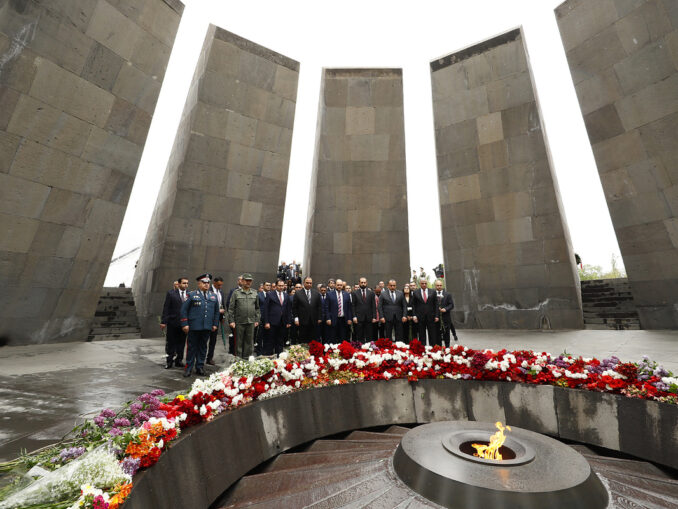
parliamentarians have publicly objected to the laying of
wreaths by foreign dignitaries at the Armenian Genocide
Memorial in Yerevan, the possible use of the term “genocide”
in the annual U.S. presidential addresses on April 24, and
the discussion of this issue in national parliaments or by
international organizations. Azerbaijani deputies have
established direct contact with foreign parliamentarians to
explain their viewpoint. At the same time, Azerbaijani
politicians, pundits, and news agencies consistently
downplay the political weight of foreign parliamentarians
who raise the genocide issue in their respective
legislatures.
Moreover, organizations of
Azerbaijani civil society have organized pickets and
demonstrations in front of the embassies of states in Baku,
which were feared to be taking steps towards recognizing the
Armenian Genocide. Azerbaijani television stations have also
filmed documentaries on location in Turkey recording what
they describe as acts of Armenian tyranny in Ottoman times.
A Russian television station, which is transmitted regularly
in Azerbaijan, was temporarily taken off the air when it
showed Atom Egoyan’s film “Ararat.” In October 2006, when
the French National Assembly was debating the passage of the
bill criminalizing the denial of the Armenian Genocide,
Azerbaijani Public Television and a number of private
television stations stopped showing films and clips produced
in France. Finally, hackers from Azerbaijan continually
attack Armenian sites with messages denying the Armenian
Genocide.
Azerbaijani expatriates have also
been active. On April 24, in both 2002 and 2003, Azerbaijani
deputies in the Georgian parliament attempted to block
suggestions by their Armenian colleagues to pay homage to
the memory of Armenian Genocide victims. Azerbaijani
expatriates of lesser standing have, in turn, often held
demonstrations, issued statements, held press conferences,
and organized books and photograph exhibitions in various
countries where they reside. In the United States, the
Azeris’ Union of America reported on March 15, 2006 that it
had “distributed more than 600 statements and letters
denouncing Armenian lies among American congressmen and
senators.”(5) Azerbaijanis in America also reportedly earned
the gratitude of Douglas Frantz, the managing editor of the
Los Angeles Times, by sending hundreds of letters to the
newspaper in his support, after he was criticized for
preventing the publication of an article on the genocide by
Mark Arax.(6) The State Committee on Work with Azerbaijanis
Living Abroad seems to be the conduit of much of the
information on such activities in the Azerbaijani diaspora.
There is also evidence that the Azerbaijani embassies are
often directly involved in organizing some of the said
demonstrations by Azerbaijani expatriates.
Among the books distributed by
Azerbaijani activists in order to propagate their own views
to foreigners are some of the publications that have been
printed in Baku since 1990 in Azerbaijani, Russian and
English. Some of these works are authored by Azerbaijanis;
others are Russian-language translations (and, in one case,
a Romanian translation) of works by George de Maleville and
Erich Feigl, and of Armenian Allegations: Myth and Reality:
A Handbook of Facts and Documents, compiled by the Assembly
of Turkish American Associations—all acclaimed by the
supporters of the Turkish state-approved thesis regarding
the 1915 deportations. In June 2001, Baku State University
invited Feigl to Azerbaijan. He was later awarded the Order
of Honor by President Ilham Aliyev. In August 2002, Samuel
A. Weems, the author of Armenia: Secrets of a Christian
Terrorist State, also visited Baku at the invitation of the
Sahil Information and Research Center.
Former and serving Turkish
diplomats, as well as Turkish and Azerbaijani
parliamentarians, have repeatedly called for further
cooperation and the development of a common strategy—both at
the official and civil society levels—to foil Armenian
lobbying efforts. Part of this cooperation is within the
realm of Turkish and Azerbaijani academia; conferences
dedicated fully to the Armenian issue or panels on this
topic within the confines of broader academic
gatherings—with the participation of Azerbaijani, Turkish,
and sometimes other experts—have taken place frequently in
Baku, Istanbul, Erzerum, and other locations. Among the
longer-term projects, one may point out that the Turkish
Historical Society, Baku State University, the Institute of
Azerbaijani History, and the Association of Businessmen of
Azerbaijan-Turkey established a joint working group on May
15, 2006 to make the international community aware of the
Armenian issue. It would meet once every three months,
alternating between Baku and Ankara. The following year, the
League of Investigating Journalists in Azerbaijan launched a
Center for Armenology, where five specialists, mostly
immigrants from Armenia, would work. This center has
reportedly established ties with Erzerum University, which
already has a center on what it describes as the “alleged
Armenian Genocide.”
Turkish-Azerbaijani cooperation
against the Armenian Genocide recognition campaign is also
evident among the Turkish and Azerbaijani expatriate
communities in Europe and the United States. Indeed, some of
the demonstrations mentioned above as the activities of the
Azerbaijani diaspora were organized in conjunction with
local Turkish organizations. Within Turkey, among the Igdir,
Kars, and Erzerum residents, who consider themselves victims
of an Armenian-perpetrated genocide, and who filed a lawsuit
against the novelist Orhan Pamuk in June 2006, were also
ethnic Azerbaijanis; their ancestors had moved from
territories now part of Armenia.
Azerbaijanis, like Turks, are very
interested in having the Jews as allies in their struggle
against the Armenian Genocide recognition campaign. Like
Turks, Azerbaijanis do not question the Holocaust. However,
they liken the Armenians to its perpetrators—the Nazis—and
not its victims—the Jews—as is the case among Holocaust and
genocide scholars. The Azerbaijanis argue that Jews should
join their efforts to foil Armenian attempts at genocide
recognition because there was also a genocide perpetrated by
Armenians against Jews in Azerbaijan, at the time of the
genocide against Azerbaijanis in the early 20th century.
They repeatedly state that several thousand Jews died then
because of Armenian cruelty. The support of Jewish residents
of Ujun (Germany) to public events organized by the local
Azerbaijanis was attributed to their being provided with
documents that listed 87 Jews murdered by Armenians in Guba
(Azerbaijan) in 1918.(7)
Yevda Abramov, currently the only
Jewish member of the Azerbaijani parliament, is prominent in
pushing for such joint Azerbaijani-Jewish efforts. He
consistently seeks to show to his ethnic Azerbaijani
compatriots that Israel and Jews worldwide share their
viewpoint regarding the Armenian Genocide claims. In August
2007, he commented that “one or two Jews can recognize [the]
Armenian genocide. That will be the result of Armenian
lobby’s impact. However, that does not mean that Jews
residing in the United States and the organizations
functioning there also recognize the genocide.” He explained
that because expenditures for election to the U.S. Congress
are high, some Jewish candidates receive contributions from
the Armenian lobby and, in return, have to meet the
interests of this lobby. According to Abramov, “except [for
the] Holocaust, Jews do not recognize any [other] event as
genocide.”(8)
Azerbaijani arguments that Armenians
perpetrated a genocide against Azerbaijanis and Jews in the
early 20th century have received little attention outside
Azerbaijani circles. However, when the issue was touched
upon in a contribution to the Jerusalem Post by Lenny
Ben-David, a former Israeli adviser to the Turkish Embassy
in Washington, D.C. on Sept. 4, 2007, his article was also
quickly distributed by the Azeri Press Agency. Ben-David
called on Israel and Jewish-Americans to be careful
regarding Armenian claims against Turkey. He listed a number
of instances when—he believed—Armenians had massacred
hundreds of thousands of Turkish Muslims and thousands of
Jews. “Recently, Mountain Jews in Azerbaijan requested
assistance in building a monument to 3,000 Azeri Jews killed
by Armenians in 1918 in a pogrom about which little is
known,” he wrote.(9)
Even if the official Turkish and
Azerbaijani positions are in total agreement regarding the
denial of the Armenian Genocide, some tactical differences
can be discerned when analyzing Azerbaijani news reports in
recent years. For example, Azerbaijani calls to impose
sanctions against states whose legislatures have recognized
the Armenian Genocide have never gone beyond the rhetoric.
In 2001, they were openly condemned by President Heydar
Aliyev. On a few other occasions, suspicions, not to say
fears, can also be noticed, when one of the two parties
becomes anxious that the other partner may desert the common
cause and appease the Armenian side at its own expense.
Most of these Azerbaijani efforts to
correct what they perceive as purposefully distorted history
are directed toward audiences in third countries, not in
Armenia. For Armenians, on the other hand, the chief
opponents in their quest for the international recognition
of the Armenian Genocide remain the Turkish state and those
segments of Turkish society, evidently the majority, which
have internalized the official viewpoint. For most
Armenians, the support this standpoint is increasingly
receiving from Azerbaijan is still at most a sideshow. They
still seem unaware of the growing Azerbaijani engagement in
this issue. The “war of words” between Armenian and
Azerbaijani officials remain largely confined to mutual
accusations of destroying historical monuments. On certain
occasions, one side or the other dubs the mixture of acts of
neglect and vandalism by the other as “Cultural Genocide,”
while at the same time denying that their own side has any
case to answer.
However, mutual accusations of the
destruction of monuments are just the tip of the iceberg in
a larger interpretation of demographic processes in
Transcaucasia in the last 200 years as one, continual
process of ethnic cleansing. Within this context, the term
“genocide” is often used as shorthand to indicate slow, but
continuing ethnic cleansing, punctuated with moments of
heightened violence also serving the same purpose. Indeed,
where the contemporary Azerbaijani attitude toward Armenia
departs from Turkey’s is now the official standpoint in Baku
that the Armenians have pursued a policy of genocide against
the Azerbaijanis during the past two centuries.
While the Turkish state and dominant
Turkish elites vehemently object to the use of the term
“genocide” to describe the Armenian deportations of 1915,
and while some Turkish historians, politicians, and a few
municipal authorities have accused the Armenians themselves
of having committed genocide against the Ottoman
Muslims/Turks—in their replies to what they say are Armenian
“allegations”—this line of accusation has never been
officially adopted, to date at least, by the highest
authorities. It has not become a part of state-sponsored
lobbying in foreign countries.
However, Azerbaijani efforts have
taken a different direction over the past few years.
Azerbaijani officials—even those of the highest rank—now
assert repeatedly that Armenians have committed “the real
genocide,” resulting in the death or deportation of up to
two million Azerbaijanis in the last 200 years. Armenians,
they say, invaded Azerbaijan’s historical lands, ousted its
population, created an Armenian state, and falsified history
through the destruction or “Armenianization” of historical
Azerbaijani monuments and changing geographical names.
Azerbaijan has even made a few timid, and so far
unsuccessful, attempts to have the Parliamentary Assembly of
the Council of Europe (PACE) approve a document adopting
this viewpoint. In March 2007, Iosif Shagal, the head of the
Israel-Azerbaijan inter-parliamentary association,
acknowledged that the Knesset had received documents about
the genocide committed against Azerbaijanis.
In 1998, President Heydar Aliyev
decreed March 31 as Genocide Day—an annual day of national
mourning in Azerbaijan. It marks all episodes of genocide
against Azerbaijanis by Armenians since the turn of the 20th
century. Four specific timeframes were highlighted as
periods of intense Armenian persecution and massacres. The
first was 1905-07, when Azerbaijanis say that tens of
thousands of civilians were killed in Yerevan, Vedibasar,
Zangezur, and Karabagh, while hundreds of settlements were
razed to the ground. Then, following the Communist
Revolution in 1917, the Azerbaijani people reportedly faced
a new series of calamities over a period of a year and a
half. Tens of thousands were killed by Armenians—with
communist support—in Baku beginning on March 31, 1918. (This
is the symbolic date chosen to commemorate all acts of
violence against the Azerbaijanis.) Azerbaijanis see a third
major episode of this Armenian policy of genocide in what
they describe as the mass deportation of thousands of
Azerbaijanis from Soviet Armenia from 1948-53. Finally, the
last intensive stage of Armenian persecution coincides with
the most recent phase of the Karabagh conflict, which began
in 1988.
Since 1998, a series of annual
rituals has been developed in Azerbaijan to mark the
Genocide Day, including a special address by the Azerbaijani
president, the lowering of national flags all over the
country, and a procession by officials, diplomats, and
scores of ordinary citizens to Baku’s Alley of Martyrs.
Ceremonies are also held in other parts of the country,
along with classes dedicated to the Genocide Day in
educational institutions and exhibitions. Memorials have
already been erected in Guba, Nakhichevan, Shamakha, and
Lankaran. Relevant events are also organized in Azerbaijani
embassies abroad.
Outside the confines of Azerbaijani
state structures, Sheikh ul-Islam Pashazada also appealed to
the world in 2002 to recognize the events of March 31, 1918
as genocide. Azerbaijani scholars and politicians have
propagated this new thesis during conferences in Turkey. On
April 24, 2003, a group of writers and journalists set up an
organization called “31 March” to compensate for what they
thought were the feeble activities of the state structures
and public organizations in this sphere. Action in this
regard is also gradually spreading to the Azerbaijani
diaspora and involving Turkish expatriates living in Europe.
Among all instances of mass murder
specified in the Azerbaijani presidential decree on
genocide, the massacre in the village of Khojaly in
Mountainous Karabagh on Feb. 26, 1992 is given the most
prominence. Its anniversary is now observed annually with
rallies and speeches—in addition to the annual Genocide Day
on March 31. In 1994, four years before the formal adoption
of the Genocide Day, the Azerbaijani National Assembly had
already recognized the events in Khojaly as genocide and
requested parliaments throughout the world to recognize it
as such. Similar requests have been repeated since, both by
the country’s successive presidents and other public
figures. The massacre/genocide of Khojaly also comes up
regularly—and in its own right—in joint academic and
educational activities by Turkish and Azerbaijani scholars.
These Azerbaijani arguments that
they continue to be the target of a genocidal campaign by
Armenians is going hand in hand these days with the
historical thesis that Armenians are newcomers to the
territories they are now living on, and that they have taken
control of these territories through a premeditated campaign
of genocide and ethnic cleansing. The origins of this modern
Azerbaijani interpretation of Armenian history go back at
least to the territorial claims that the Azerbaijanis
presented at the Paris Peace Conference in 1919. It also
manifested itself in part during the above-mentioned “paper
wars” between Soviet Armenian and Azerbaijani historians
from the mid-1960’s. Modern-day Azerbaijanis put the
beginning of their woes with the Russian occupation of
Transcaucasia in the early 19th century. They consider the
districts of Yerevan, Zangezur, and the Lake Sevan basin as
being, until then, historic regions of Azerbaijan; but the
Russian conquerors deported their Azerbaijani population and
settled in their stead Armenian migrants from the Ottoman
Empire and Iran. Azerbaijanis also argue that Yerevan was an
Azerbaijani city until it was granted to Armenia in 1918.
The Bolsheviks are accused of having given additional
territories to Armenia when the Soviet regime was installed.
And, finally, it is pointed out that Armenians have
conquered further territories during the recent war and that
they still harbor irredentist designs toward Nakhichevan.
Within the context of this recent
historical interpretation, it is becoming more frequent in
Azerbaijan to describe the territories of present-day
Armenia as Western Azerbaijan, and the ethnic Azerbaijanis,
who lived in Armenia until 1988, as Western Azerbaijanis.
There exists a non-governmental organization called the
Western Azerbaijani Liberation Movement, established in
2005, which aims to protect the interests of the Western
Azerbaijani emigrants, including their right to return to
their original places of residence. Other related demands go
further, from giving these Western Azerbaijanis—after their
return—a status of an enclave within Armenia to the outright
annexation of Yerevan, Zangezur, and other “Azeri
territories” in today’s Armenia to Azerbaijan.
Most issues discussed in this
article are of direct relevance to the future of
Armenian-Turkish and Armenian-Azerbaijani relations. Any
Armenian-Turkish or Armenian-Azerbaijani efforts to overcome
the existing, respective antagonisms should necessarily
address these Azerbaijani (and similar Turkish and Armenian)
convictions and attitudes. For, understanding them will in
all likelihood open the way to a better grasp of the
problematic situation in Eastern Asia Minor and
Transcaucasia, and may lead to those involved in conflict
resolution to delve deeper into issues of identity, fears,
irredentist aspirations, and prejudices, which have become
an accepted part of the respective public discourses in
these countries and their respective educational systems.
To escape the existing pattern of
mutual accusations, additional research appears to be
necessary to write a historical narrative acceptable to
specialists on both sides of the political divide, which is
based not only on a comprehensive and scientific study of
the available facts, but which also addresses the various
social, political, and ideological concerns of all the
protagonists involved. The Azerbaijani attitudes described
here are comparable not only to positions taken in Turkey,
but also to some of the prevalent attitudes among Armenians
vis-à-vis their Turkish and Azerbaijani neighbors.
Limitations of space forced us to avoid this dimension
altogether within this particular article. However,
comparative studies of the Armenian and Azerbaijani
historical narratives may be useful in separating historical
facts from ideological statements and may provide an
intellectual climate whereby the future coexistence of these
two nations as non-antagonistic neighbors can be
contemplated and discussed.
This study also indicates that the
increasingly politicized use of the term “genocide” among
Armenians, Turks, and Azerbaijanis is leading (perhaps
unconsciously) to the trivialization of this concept,
whereby its relatively strict definition provided for in the
1948 United Nations Convention is being replaced by a looser
meaning. The word “genocide” often becomes, in the context
described in this article, a synonym for “ethnic cleansing”
or even smaller-scale and ethnically motivated massacre or
murder. The frequent use of the term “genocide” by Armenians
to describe the pogrom in Sumgait (Azerbaijan) in February
1988 is also indicative of this trend. While it is beyond
doubt that the murder of individuals, massacres, and acts of
ethnic cleansing deserve punishment as criminal offences no
less than a crime of genocide, maintaining a healthy respect
towards the distinctions, which scholarship has devised over
decades to define the various types of mass slaughter,
appears to be necessary more than ever in order to have a
more accurate understanding of the peculiarities of various
episodes in history and similar occurrences in the world
today.
Finally, the enthusiasm shown by
Azerbaijan in denying the Armenian Genocide (when modern-day
Armenians do not usually hold it responsible for committing
the crime) brings to attention the fact that denial is not
necessarily only “the last phase of genocide”; genocide can
also be denied by groups other than the perpetrators and/or
their biological or ideological heirs. Genocide can be
denied by the new foes of the (old) victims, and again the
Armenian case is not unique and can become the topic of yet
another comparative study.
EndNotes
1) This article is an abridged version of the paper “My
Genocide, Not Yours: The Introduction of the ‘Genocide’
Paradigm to the Armeno-Azerbaijani ‘War of Words,’” which
the author presented at the Sixth Workshop on Armenian
Turkish Scholarship in Geneva on March 1, 2008.
2) This theory has continued to flourish in Azerbaijan after
the collapse of the Soviet system and now often covers all
Christian monuments on the territory of the Republic of
Armenia, as we shall see toward the end of this article.
3) Rafig, “A genuine genocide was committed in Khojaly: The
Spiritual Board of Muslims of the Caucasus hails the present
position of the US Congress,” Yeni Musavat, Baku, Oct. 23,
2000.
4) “Azeri analyst sees pro-Armenian US move as assault on
Islam,” Day.az, Oct. 13, 2007.
5) E. Abdullayev, “Azeri: Meeting to Denounce Lies on
Armenian Genocide to Be Held in New York April 22,” Trend,
March 15, 2006.
6) “Los Angeles Times’ Armenian Journalist Leaves Newspaper
for Biased Article about Alleged Armenian Genocide,” Azeri
Press Agency, June 20, 2007.
7) J. Shakhverdiyev, “Germans of Jewish Descent Protest
Faked Armenian Genocide,” Trend, April 24, 2006.
8) I. Alizadeh, “Jews Recognize no Event as Genocide except
Holocaust,” Trend, Aug. 24, 2007. This statement by Abramov
that Jews recognize only the Holocaust as a genocide
contradicts his use of phrases like “the genocide of
Azerbaijani Jews perpetrated by the Armenians” or his
reference that the massacres at Khojaly in 1992 constituted
genocide.
9) “Israeli Diplomat Lenny Ben-David: Armenians Massacred
Hundreds of Thousands of Muslims and Thousands of Jews,”
Azeri Press Agency, Sept. 6, 2007. |