TOC

Editorial: The Genocide and Karabagh

By Jason Sohigian

The Armenian nation has achieved several recent successes, particularly in Europe, with regard to recognition of the Armenian Genocide. Because of those successes, however, we have become the target of a wide-scale political offensive and concomitant maneuverings. Consequently, we have also experienced some setbacks and continue to face some daunting challenges.

Last year, in the US Congress, the Armenian Genocide Resolution was defeated because of heavy pressure from Turkey, the US oil industry, the State Department, the Jewish lobby, and President Clinton. We nearly won, despite having had to confront such heavyweights.

Armenia is now also forced to defend itself in a tough battle in the public relations war over Karabagh. It is under attack by Azerbaijan and its accomplices in the West, particularly the United States, which are portraying Armenia as the aggressor--for having democratically called for self-determination, and for having acted in self-defense in response to Azerbaijani military attacks.

Armenia is also about to find out how strong Congressional support is for Section 907 of the Freedom Support Act, which restricts US aid to Azerbaijan until it lifts its illegal and life-threatening blockade of Armenia and Karabagh. Moreover, we will soon find out whether President Bush will honor his campaign pledge to acknowledge the Armenian Genocide on April 24.

While having to contend with these challenges, we've continued to achieve successes.

The Maryland General Assembly--despite serious opposition from the State Department (specifically, Secretary of State Colin Powell), the Baltimore Jewish Council, and the Turkish Embassy--passed an Armenian Genocide Resolution.

Similar resolutions and measures have also succeeded in several other states this year, including in Arkansas, where the governor noted the ongoing denial of the Genocide by Turkey and reaffirmed the need for reparations.

Nevertheless, we must continue to remain vigilant and miss no opportunities to press our case. For example, during the recent public outcry over the Taliban destruction of Buddhist monuments in Afghanistan, we should immediately have drawn a parallel between the acts of the Taliban and the ongoing destruction of Armenian churches and historical monuments in Turkey as well as Azerbaijan.

We Armenian-Americans have a special responsibility in this area. In particular, we must constantly keep a watchful eye on the US State Department. It has consistently opposed efforts to recognize the Armenian Genocide, and it has floated proposals such as the so-called Goble Plan proposing that Armenia give up its southern Meghri region bordering Iran in return for Karabagh.

Paul Goble seems now to have turned his attention to the Genocide issue. His latest "analysis" argues that the recent New York Life insurance settlement on policies from the Armenian Genocide will work against the cause of recognition of the Genocide, because Turkey will fear what will be more and larger claims for restitution.

Apparently, the anti-Armenian propaganda campaign is in full swing. Goble has yet again constructed an artificial quid-pro-quo: Armenians must give up Genocide reparations in return for Genocide recognition. Before, it was that we must give up Meghri in return for Karabagh.

Earlier, in the late 1980s and early 1990s, the argument had been put forth that we must give up Karabagh if we want to keep Armenia. That argument was even adopted at the highest levels of the Armenian government, and by various Armenian political circles. But through the sheer will of the Armenian people, those artificial arguments were rejected once and for all.

By having gained de-facto independence for Karabagh, we have proven that as a nation we are capable of rejecting half-baked political arrangements that do not serve our national interests.

Regarding his Meghri proposal, Goble eventually admitted that it was unrealistic because he had miscalculated Meghri's significance. It's about time that that he and his kind realize that they have also miscalculated the Armenians' resolve regarding Genocide recognition and reparations.


US Shows Bad Faith Toward Armenians

By Jirayr Beudjekian

President George W. Bush broke his campaign promise to publicly recognize the Armenian Genocide on April 24, 2001. This type of bad faith is not something new to the Armenian-American community or the rest of the Armenian nation scattered across the world as a result of the mass deportations perpetrated by the predecessor of modern Turkey before and during World War I.

Before President Bush, President Bill Clinton not only broke his campaign promise but personally requested that an Armenian Genocide Resolution be removed from the agenda of the US Congress in October 2000.

This diplomatic move by President Bush--the newly elected head of the US administration--compels each and every Armenian to think more than twice about trusting promises made by the US administration.

The first thing on the agenda is the negotiations for a settlement of the Nagorno Karabagh conflict, which includes extremely active participation from the US. One can't help but ask: Can Armenia trust the promises and undertakings by the US administration? Can the Armenians living in Nagorno Karabagh trust the guarantees given by the United States? Can the Armenians be assured that "the oil in Baku will not weigh heavier than Armenian blood?"

The answer is definitely "No" to all of these questions. History has taught us that justice, morality, and similar values are non-existent in politics. The Armenian people were not expecting President Bush to recognize the Armenian Genocide because of a pledge or a promise he made during his campaign. He did that hoping to court the votes of the prosperous and vocal Armenian-American community.

Something else is at play this year. The United States is trying a new approach to getting involved in the Caucasus and becoming one of the major players, rather than sitting on the sidelines, in that geographical zone.

By playing the role of mediator in the conflict between the Armenians and Azerbaijanis, the US is trying to gain a foothold in the Caucasus. The expectation was that President Bush might adopt the right stance towards the "tragic" events of 1915 for the sake of serving the current US policy in the Caucasus.

We were proven wrong, as the United States bluntly declared through the President's statement on April 24, 2001. The US is again taking the side of Turkey by denying irrefutable historic facts that the President himself is recounting, but falling short of defining as genocide.

The US proved once again that it gives priority to serving Turkish rather than Armenian interests. It follows that the US is not impartial toward the Armeno-Azeri conflict. This in turn means that the US administration can't be entrusted with the role of impartial mediator.


Turkey Will Not Elude Justice

By Hayg Oshagan

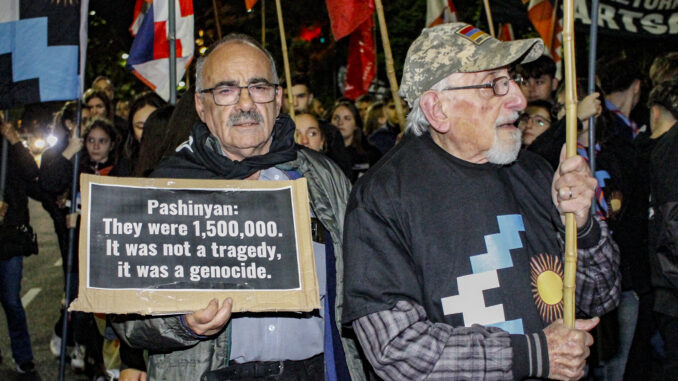
Starting in 1915 and continuing at least until 1917, the modern world's first genocide claimed the lives of 1.5 million Armenians and threw another 2-3 million into exile, emptying our historic homeland of our people.

In 1915, we entered into a struggle with the Ottoman Turks that has lasted now for 86 years. Our struggle in 1915 was one of survival, a battle to prevent the extermination of a 3,000-year old people. Today, our struggle is a battle of memory, a fight to bring justice to history, to bring justice to a nation's suffering.

The Armenian Revolutionary Federation and every organization that serves our communities, and every Armenian who feels the struggle and every politician and leader who has a moral sense, knows that eventually Turkey will accept its legacy of genocide. It will give up its immoral campaign of denial, it will admit to the Ottoman crimes, it will admit that the Ataturk Republic was built upon the shameless slaughter of an innocent Armenian population.

Of course, this is one of the reasons why Turkey continues to deny the Armenian Genocide. Ataturk did not create the modern Republic by himself. Many of the people and organizations that carried out the Genocide, in addition to the appropriated Armenian assets, played important roles in the Turkey of Ataturk, and the Turkish state today does not want to stain the legacy of Kemal Ataturk and, by implication that of the Republic, with the blood of the Armenian Genocide.

What other reasons are there for denial? The Turks are deeply aware of their image as barbarians in the eyes of Europe, a community they desperately want to join. This image of the "barbarous Turk" established over the last several hundred years is something the Republic has tried hard to overcome. But a genocide is precisely what barbarism and inhumanity is about, and admitting to the Armenian Genocide dooms the Turkish state to its true image.

And finally, perhaps the ultimate reason for denial is Turkey's attempt to escape from justice. For every injustice, there is, eventually, sooner or later, justice. And for the greatest of crimes, genocide, there will be eventually the greatest punishment. Justice will demand from Turkey recognition, it will demand reparation, and it will demand land and property for the 1.5 million martyrs and an entire nation that have endured 86 years of injustice.

And we will get what we demand. Because we live in a world today where justice is the basis of laws and laws are the basis for justice. And not only are we, the United States, a nation of laws, but we are increasingly living in a world of laws. Laws protect freedoms, provide for equality, and guarantee human rights.

And in a world of laws, justice eventually will, has to, prevail. Regardless of politics, regardless of military bases, regardless of NATO, regardless of trade, regardless of lobbying, injustice cannot survive. This is the world in which a man like General Pinochet can be brought to justice for crimes committed long ago, by courts in Spain and England, by the descendents of his victims. This is the world in which a former President, a man like Milosevic, can be arrested for crimes against humanity. This is the world in which a former Secretary of State, a man like Kissinger, is expected to be brought to trial for his role in crimes in Chile, Cyprus, and East Timor. This is the world in which 60 years after World War II, a nation like Japan apologizes to Korea for crimes committed during the war, or a nation like the United States apologizes to its Japanese citizens for human rights abuses and internment camps during the 1940s.

And it is a nation of laws and a quest for justice that allowed Armenians to sue New York Life Insurance Co., which recently agreed to an eventual financial settlement with all Armenians who lost their lives in the Genocide and who carried New York Life insurance.

And it is the pursuit of justice in a world governed by laws that has led to resolutions and recognition of the Genocide in Uruguay, Argentina, the European Parliament, the Russian Duma, Canada, Greece, Lebanon, Belgium, France, Italy, Cyprus, and the list will continue to grow.

And it is the same justice and the same laws that will require the United States government to eventually recognize the Armenian Genocide. And then, finally, justice will be served when Turkey accepts its own criminal history and submits to its punishment.

All nations and governments need to learn that injustice is never forgotten. An injustice committed against our grandparents was never forgotten by them, it was not forgotten by our parents, it lives as strongly in us, and it will be as strongly felt in our children and their children. We have fought for justice just as our parents and their parents did before us, and our children will carry the struggle into the future until one day, justice, complete justice, will belong to the Armenian nation. There is, simply, no other way.

April 24 will always be a symbol of inhumanity, of a terrible crime perpetrated upon an innocent population. But someday, it will also symbolize how justice cannot be evaded and how eventually every nation, just as every person, is accountable for their crimes in a just world.

There cannot be any other way, and we will not accept anything less.

Hayg Oshagan is a member of the ARF Central Committee of the Eastern US.


The Road to Recognition

By Senator Steven A. Tolman

On the eve of the worst conflict in human history, Adolph Hitler invoked murderous precedent to justify the imminent slaughter of Europe's Jewish population. He boldly declared: "Who today remembers the extermination of the Armenians?" The answer is this: although 86 years have passed since the systematic deportation and murder of 1.5 million Armenians and many people remember the Armenian Genocide, the road to recognition has been long and hard.

Throughout the 19th century, the Armenian people survived a denial of rights and culture at the hands of the Turkish government. That century of hostility concluded with the massacres of 1894-95, when forces of the Turkish government murdered anywhere between 150,000 to 300,000 Armenians. In 1908, the Young Turks seized power through a military coup. Although they provided a new constitution and government, the Young Turks also brought new ferocity to the old policy of Armenian persecution. This violence culminated when World War I enveloped the world in chaos, cloaking the oncoming tragedy.

During World War I, the Turkish government carried out a deliberate plan to systematically exterminate the Armenian people, which Hitler's final solution consciously emulated. The Turkish government began the genocide by arresting Armenian political, religious, and intellectual leaders in Istanbul on April 24, 1915. Turkish forces methodically rounded up Armenians town-by-town and village-by-village and drove them from their homes. The deportations separated men and women, husband and wives, children and parents. The men, many of whom served the Turkish army in forced labor battalions, were summarily executed. Women and children marched to "relocation centers" where, if they survived the months of trudging through both mountain and deserts deprived of food and water, they died of exposure.

Despite the heinous nature of this slaughter, 1.5 million Armenian victims, testimony from survivors, the eyewitness accounts of foreign officials, and nearly a century of fighting for recognition, the Turkish government still denies the Armenian Genocide ever happened. Beyond this denial, however, the Turkish government spends millions of dollars every year on public relations firms and high-powered lobbyists to perpetuate this fallacy. Particularly frustrating is the Turkish government's practice of endowing university Chairs and exerting the accompanying influence to appoint scholars sympathetic to the Turkish version of events. This attempt to wipe the stain of the genocide from the modern historical record has been successful at some universities, while others, most notably UCLA, have resisted the allure of purchased history.

Due to our strategic relationship with Turkey, the United States has never officially recognized the actions of the Turkish government as genocide. In fact, members of Congress presented a resolution to Congress last year to finally recognize the Genocide, but President Clinton requested the resolution be withdrawn. The President claimed that American lives were at risk if we jeopardized our relationship with Turkey, and Congress subsequently abandoned the resolution. This is a troublesome and unfortunate position. For example, more than sixty years ago Hitler recognized the real history as well as the lack of public acknowledgment for the Armenian Genocide, and took that to be a good sign for his own plans. American non-recognition of the Armenian Genocide holds history hostage to politics, but also gives license to potentially genocidal regimes in the hope that their friends will not criticize them for political reasons.

The difficulties in the nearly century long struggle for universal recognition undoubtedly frustrates Armenians and non-Armenians alike. Thus far only a handful of governments, including Russia and Greece, and the Vatican, have publicly acknowledged this episode in history. This year, however, marks a major victory on the road to recognition. The French government became the first nation to have both the legislative and executive branches of government formally recognize the Genocide. We are fortunate enough to host the French Consul-General, as he will speak regarding this decision at the annual Armenian Genocide Commemoration at the State House on April 20. As one of twenty-five states that recognize the Armenian Genocide, the Commonwealth has a proud Armenian population and a tradition of being on the forefront of recognizing this tragedy, and this year proves no different.

This commemoration, hosted with my colleagues Representatives Rachel Kaprielian and Peter Koutoujian and Senate Majority Leader Linda Melconian, is held every April and invites the public to honor the memory of the victims and the suffering and perseverance of survivors. The stirring image and enduring courage of these people are truly an inspiration to all. To this end, I worked diligently with my colleagues and former Senator Warren Tolman to pass the Human Rights and Genocide Curriculum Bill, which developed the curriculum that public schools may utilize to instruct students about the Armenian Genocide, the Holocaust, the Great Irish Hunger, the Middle Passage Slave Trade, and other tragic episodes in history. We believe that confronting and learning from the mistakes of the past is necessary to foster an atmosphere of tolerance and prevent future tragedies. We as individuals must do our part to ensure that the memories and lessons of the Armenian Genocide will never be forgotten.

Senator Steven A. Tolman represents the Middlesex and Suffolk District of Massachusetts

Jason Sohigian is the editor of The Armenian Weekly and can be contacted at: jsohigian@hotmail.com